

Choosing an LED strip is often treated as a simple lighting decision. In practice, the strip and its power supply need to work together. Voltage, wattage, installation length, environment, and control requirements can all affect how the finished lighting system performs.
A suitable combination can provide stable brightness and easier installation. A poorly matched combination may lead to voltage drop, uneven illumination, excess heat, or reduced service life. Understanding the main specifications before installation helps avoid these problems.
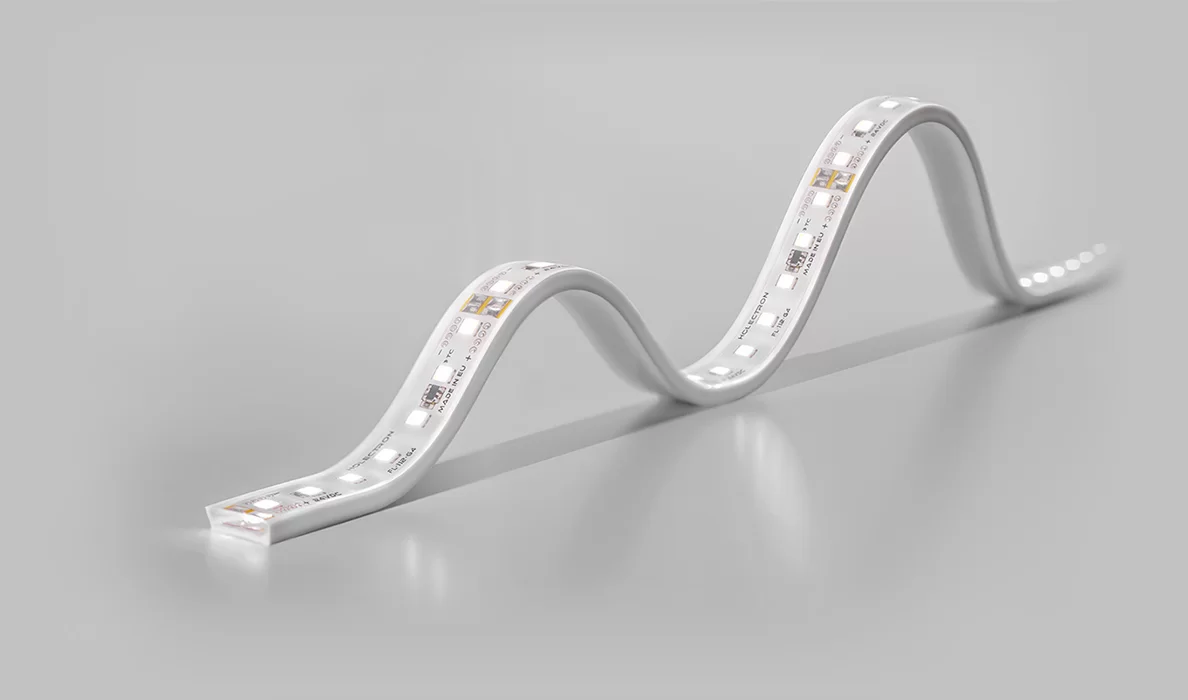
Understanding Flexible LED Strip Options
Flexible LED strips come in different LED types, voltages, sizes, brightness levels, and protection ratings. SMD5050, SMD3528, SMD2835, SMD3014, COB, and neon-style strips are designed for different lighting requirements.
For example, a 3528 strip can use 300 LEDs across five meters and operate at either 12V DC or 24V DC, with a maximum power of 4.8W per meter. A 2835 strip with 180 LEDs per meter can operate at 24V DC and reach 48W across five meters.
COB strips offer another option where continuous illumination is important. Their closely positioned light sources reduce the visible spotting that can appear with some traditional SMD strips. This can be useful for areas where the strip itself is visible or where a smooth line of light is preferred.
What to Look for in a Flexible LED Strip Factory
Product specifications matter when comparing a flexible led strip lights factory. Look at LED density, PCB construction, cutting intervals, voltage options, power consumption, adhesive backing, waterproof ratings, and available accessories.
These details can affect installation and long-term performance. For example, some 24V strips can be cut at specific intervals and reconnected with compatible accessories. A 5050 strip may contain 300 LEDs per five meters, use a 10mm-wide PCB, and offer a 120-degree viewing angle.
The installation environment should also influence the selection. Indoor cove lighting may require a different strip from an outdoor architectural application. IP65 and IP68 versions can provide additional protection where moisture or water exposure is expected.
Matching Voltage With the Power Supply
Voltage is one of the first specifications to check. A 12V LED strip requires a compatible 12V power supply, while a 24V strip requires a 24V power supply. Using an unsuitable voltage can cause poor performance or damage the lighting components.
A 24V system can also be useful for longer strip runs because it generally experiences less voltage drop than an equivalent 12V system. With excessive voltage drop, LEDs farther from the power source may appear progressively dimmer.
Wattage is equally important. Calculate the strip’s total power requirement before choosing the power supply. If a strip consumes 10W per meter and the installation requires five meters, the basic load is 50W. The selected power supply should have enough capacity to handle that load without operating continuously at its limit.
Selecting an Appropriate LED Power Supply
When evaluating an LED Power Supply manufacturer, consider more than the output rating. Check whether the available power supplies match the voltage, wattage, installation environment, and physical space required by the project.
Different installations may call for different designs. An IP20 power supply can suit appropriate indoor environments, while rainproof or waterproof options may be more suitable for locations exposed to moisture. Constant-voltage supplies are commonly used with LED strips designed for fixed voltage operation.
The power supply should also provide stable output during normal operation. This can help maintain consistent brightness and reduce problems such as flickering. For installations using dimmers or RGB controllers, compatibility between the controller, strip, and power supply should also be confirmed.
Considering Installation Conditions
The environment can change which LED strip is appropriate. Indoor furniture, shelves, ceilings, and display areas may use non-waterproof strips with adhesive backing. Outdoor signs, pathways, canopies, and architectural features may require additional protection.
For example, some 5050 LED strips are available with IP65 or IP68 protection. Waterproof versions can be considered where exposure to water is part of the installation conditions. A waterproof rating should still be matched to the actual environment rather than selected simply because it has a higher number.
Installation length also deserves attention. Longer runs can experience voltage drop, particularly with lower-voltage systems. Dividing long installations into suitable sections or using a 24V system can help maintain more consistent illumination.
Control Systems and Accessories
Some LED projects require more than a basic power supply. RGB strips may need a compatible controller for color selection, brightness adjustment, and lighting effects.
An RGB touch controller, for example, can work with 12V to 24V systems and provide PWM dimming. It can support multiple color modes and remote control operation. The controller’s maximum load must match the total power requirement of the connected LED strips.
Connectors, aluminum profiles, mounting accessories, and suitable adhesive backing can also influence the installation result. These components should be selected according to the strip type and installation surface.
A Practical Selection Checklist
Before purchasing the components, check the following points:
- Confirm whether the LED strip operates at 12V or 24V.
- Calculate the total strip length and power consumption.
- Choose a power supply with sufficient output capacity.
- Check the IP rating according to the installation environment.
- Consider voltage drop for longer runs.
- Confirm compatibility with dimmers and controllers.
- Check the strip’s cutting length and connection method.
- Allow sufficient space for heat management around the power supply.
Company Information
Shenzhen Dekingled Co., Ltd. was established in 2014, with its manufacturing address at 4th Floor, Building C, SanMing Industrial Park, Shiyan Town, Bao’an District, Shenzhen, China. The company lists technical support, fast delivery, cost-effective solutions, and product quality among its service advantages.
The company’s product range includes flexible LED strips, COB LED strips, waterproof strips, neon lighting, controllers, and LED power supplies. Its featured free-cutting 12V and 24V COB LED strip is designed to address certain installation constraints where flexible cutting options are useful.
Building a Compatible LED Lighting System
The best LED lighting setup starts with compatibility. The strip needs the correct voltage and sufficient power, while the power supply needs to suit the installation environment and electrical load. Controllers and accessories must also match the system specifications.
Taking a few minutes to check these details before installation can prevent common problems such as uneven brightness, overheating, and unsuitable connections. Whether the project involves home lighting, signage, architectural features, or commercial spaces, matching the LED strip with the right power supply creates a more predictable and practical lighting system.
You May Also Read: Duncan Hwy