

The GRE Quantitative Reasoning section evaluates a student’s ability to understand mathematical concepts and apply them effectively under time pressure. Geometry is one of the important areas tested in this section because it measures logical thinking, visual reasoning, and problem-solving skills. Learning GRE geometry formulas helps students solve questions related to shapes, angles, measurements, and spatial relationships more accurately while reducing the time spent on calculations.
Preparing for geometry questions requires more than memorizing equations. Students need to understand the purpose behind each formula and recognize situations where a specific equation should be used. A strong foundation in geometry allows test takers to approach different question types confidently. Using study resources such as a GRE geometry formulas PDF can also make revision easier by providing a quick reference guide for important equations, examples, and concepts.
Understanding the Role of Geometry in the GRE Quantitative Section
Geometry questions on the GRE are designed to test practical application rather than advanced mathematical theory. These questions may involve calculating areas, finding missing lengths, analyzing angles, comparing geometric figures, or solving problems with coordinate systems. Since the exam includes various difficulty levels, understanding fundamental geometry concepts is essential for achieving a strong Quantitative Reasoning score.
Many GRE geometry problems require students to combine multiple concepts in one question. For example, a problem may include a triangle inside a circle or a shape placed on a coordinate plane. Knowing GRE geometry formulas helps students quickly identify the required method and avoid unnecessary calculations. A good preparation strategy involves learning formulas, practicing real GRE-style problems, and understanding how different concepts connect.
Essential GRE Geometry Formulas for Lines, Angles, and Basic Shapes
Lines and angles create the foundation of geometry and appear in many GRE questions. Students should understand basic angle relationships because they often provide clues for solving more complex problems. Important concepts include complementary angles, which add up to 90 degrees, and supplementary angles, which add up to 180 degrees. Vertical angles are another important concept because opposite angles created by intersecting lines always have equal measurements.
Parallel lines and transversal relationships are also commonly tested in the GRE Quantitative section. When a line crosses two parallel lines, different angle patterns are created that allow students to determine unknown values. Although these topics may not require complicated formulas, they require careful observation and logical thinking. Building confidence with these basic concepts creates a strong foundation for mastering more advanced GRE geometry formulas.
GRE Geometry Formulas for Triangles and Their Applications
Triangles are among the most frequently tested shapes in GRE geometry because they involve many important relationships and formulas. Students should understand different triangle types, including equilateral, isosceles, scalene, and right triangles. Each type has unique properties that can help solve questions faster. Knowing triangle formulas allows students to calculate missing measurements and analyze geometric relationships effectively.
One of the most important triangle formulas is the area formula: Area = ½ × base × height. The Pythagorean theorem, represented as a² + b² = c², is also essential for solving right triangle problems. Students should also memorize the special properties of 45-45-90 and 30-60-90 triangles because these shortcuts frequently appear on the GRE. Understanding these concepts makes triangle questions much easier to manage during the exam.
GRE Geometry Formulas for Circles and Circular Measurements
Circle problems are an important part of GRE geometry because they test knowledge of measurements, angles, and relationships between different parts of a circle. Students should understand the basic components of a circle, including radius, diameter, circumference, chord, tangent, and central angle. These concepts often appear together in GRE questions, requiring a complete understanding of circular properties.
The most important circle formulas include the area formula A = πr² and the circumference formulas C = 2πr or C = πd. Students should also learn formulas for arc length and sector area because these concepts are frequently connected with angle measurements. Having strong knowledge of circle formulas allows students to solve different types of GRE geometry problems quickly and accurately.
GRE Geometry Formulas for Quadrilaterals and Polygons
Quadrilaterals and polygons represent another important category of GRE geometry questions. Students should know the formulas for common shapes such as squares, rectangles, parallelograms, and trapezoids. For example, the area of a rectangle is calculated by multiplying length by width, while the area of a parallelogram is found by multiplying the base by the height.
Polygon questions often involve angle calculations and shape properties. Understanding the formula for the sum of interior angles helps students solve problems involving polygons with different numbers of sides. Regular practice with these shapes improves speed and accuracy. Including quadrilateral and polygon formulas in a complete GRE geometry formulas study plan ensures that students are prepared for a wide range of possible exam questions.
GRE Geometry Formulas for Coordinate Geometry
Coordinate geometry combines algebra and geometry, making it a valuable topic in the GRE Quantitative section. Students should be familiar with important formulas such as the distance formula, midpoint formula, and slope formula. These equations help analyze points, lines, and shapes placed on a coordinate grid.
The distance formula allows students to calculate the length between two points, while the midpoint formula identifies the exact center between coordinates. The slope formula helps determine the direction and steepness of a line. Coordinate geometry questions often appear challenging at first, but understanding these formulas makes them more manageable. Practicing different coordinate problems helps students develop confidence and improve their problem-solving speed.
GRE Geometry Formulas for 3D Shapes and Solid Geometry
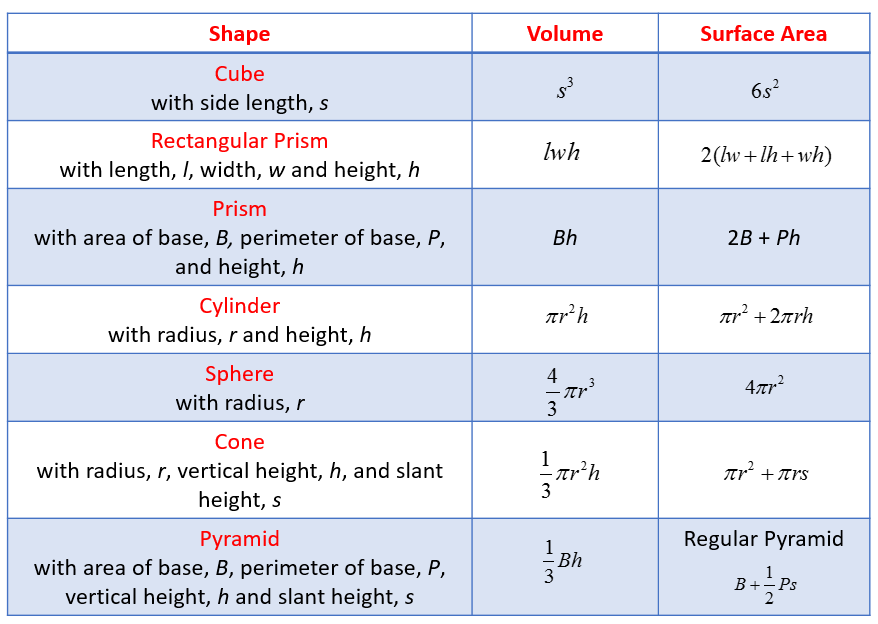
Three-dimensional geometry tests a student’s understanding of volume, surface area, and spatial relationships. Common GRE solid geometry topics include cubes, rectangular solids, cylinders, and spheres. These questions require students to visualize objects and apply the correct formulas to find measurements.
Important formulas include the volume of a cube, which is side³, and the volume of a rectangular solid, which is length × width × height. The cylinder volume formula is πr²h, while sphere calculations involve formulas for volume and surface area. Understanding these equations and practicing with diagrams helps students solve 3D geometry questions more efficiently.
Using a GRE Geometry Formulas PDF for Effective Preparation
A GRE geometry formulas PDF can be a helpful resource for students preparing for the exam because it provides quick access to essential equations. A useful formula sheet should include important formulas, diagrams, definitions, and examples. Having this information organized in one place allows students to review concepts efficiently during study sessions.
Students can improve their preparation by organizing formulas into categories such as triangles, circles, polygons, coordinate geometry, and solid shapes. Regular review helps strengthen memory and reduces confusion during the actual test. A well-prepared GRE geometry formulas PDF can serve as a reliable revision tool throughout the entire GRE preparation process.
Common Mistakes Students Make With GRE Geometry Formulas
Many students make mistakes in geometry because they focus only on memorization instead of understanding. Using the wrong formula, confusing measurements, or ignoring important details in a question can lead to incorrect answers. For example, some students confuse radius and diameter or forget to square the radius when calculating circle areas.
Another common mistake is rushing through calculations without checking units or reviewing the final answer. The best way to avoid these errors is through consistent practice and careful problem analysis. Understanding how and why formulas work allows students to apply GRE geometry formulas correctly in different situations.
Tips to Master GRE Geometry Formulas and Improve Your Score
Mastering geometry requires regular practice, patience, and a strategic approach. Students should review formulas frequently and practice applying them to different GRE-style questions. Creating a personal formula sheet, reviewing mistakes, and practicing timed problems can significantly improve performance.
Visual learning is also beneficial for geometry because diagrams help students understand relationships between shapes and measurements. Combining formula knowledge with problem-solving techniques allows students to work faster and more accurately. With consistent preparation and effective study methods, students can confidently handle geometry questions on the GRE.
Conclusion
GRE geometry formulas are essential tools for success in the Quantitative Reasoning section. They help students solve problems involving triangles, circles, polygons, coordinate systems, and three-dimensional shapes. Understanding these formulas not only improves accuracy but also helps reduce the time needed for solving geometry questions during the exam.
Using resources like a GRE geometry formulas PDF, practicing regularly, and focusing on concepts rather than memorization can create a strong preparation strategy. With dedication and proper guidance, students can build confidence, improve their mathematical skills, and achieve better results on the GRE.
Frequently Asked Questions
What are GRE geometry formulas?
GRE geometry formulas are mathematical equations used to solve geometry problems involving shapes, angles, areas, distances, and volumes in the GRE Quantitative section.
Which GRE geometry formulas should I memorize?
Students should know formulas for triangles, circles, quadrilaterals, coordinate geometry, and 3D shapes, including area, perimeter, volume, and distance formulas.
Does the GRE provide geometry formulas during the test?
The GRE provides some basic information, but students should memorize essential geometry formulas to save time during the exam.
What is included in a GRE geometry formulas PDF?
A GRE geometry formulas PDF usually includes important equations, diagrams, examples, and quick reference notes for GRE preparation.
Are circle formulas important for the GRE?
Yes, circle formulas such as area, circumference, arc length, and sector area are commonly tested in GRE geometry questions.
How can I learn GRE geometry formulas quickly?
Regular practice, creating a formula sheet, and solving GRE-style geometry problems can help improve formula retention.
What geometry topics are tested on the GRE?
Common topics include triangles, circles, polygons, coordinate geometry, angles, and solid geometry.
Why are GRE geometry formulas important?
Knowing the right formulas helps students solve geometry questions faster, improve accuracy, and achieve better scores in the GRE Quantitative section.
You May Also Read: Circle Geometry Formulas