

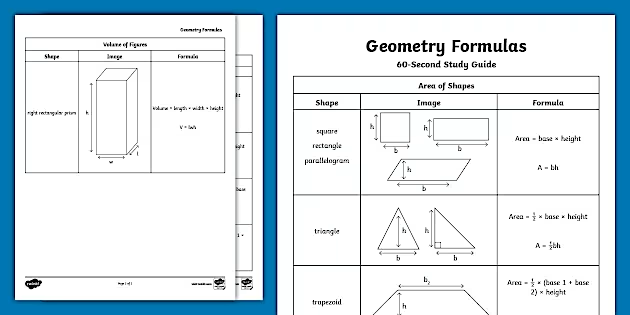
Geometry is one of the most important branches of mathematics because it helps people understand the relationship between shapes, sizes, angles, and measurements. From calculating the dimensions of a building to designing objects and analyzing patterns, geometry is used in many areas of life. Learning basic geometry formulas gives students the ability to solve mathematical problems faster while developing a deeper understanding of how shapes and measurements connect.
Basic geometry formulas are essential tools for students, teachers, and professionals because they provide simple methods for finding area, perimeter, volume, and other measurements. Instead of solving problems through lengthy calculations, formulas offer organized solutions that save time and improve accuracy. A strong understanding of these formulas creates a foundation for advanced mathematics, engineering, architecture, and other technical fields.
What Are Basic Geometry Formulas?
Basic geometry formulas are mathematical equations that help calculate different properties of geometric shapes. These equations are created from the relationships between measurements such as length, width, height, radius, and angles. By applying the correct formula, students can determine important values like the area of a triangle, the circumference of a circle, or the volume of a cube.
A complete collection of basic geometry formulas includes equations for two-dimensional and three-dimensional shapes. Students commonly study formulas for squares, rectangles, triangles, circles, cubes, cylinders, and spheres. Many learners use a basic geometry formulas sheet or basic geometry formulas PDF to keep these important equations organized and available during study sessions.
Basic Geometry Formulas List for Common 2D Shapes
Two-dimensional shapes are flat figures that have length and width but do not have depth. Understanding their formulas is one of the first steps in learning geometry. A basic geometry formulas list usually includes calculations for area and perimeter because these measurements are frequently used in school mathematics and real-world situations.
For a square, the area is found by multiplying the side length by itself, while the perimeter is calculated by adding all four sides. A rectangle uses length and width to determine its area and perimeter. These formulas are simple but extremely important because they help students understand how measurements describe the size and boundary of different shapes.
Triangles are another major part of geometry learning. The area of a triangle is calculated using the base and height, while the perimeter is found by adding the lengths of all sides. A basic geometry formulas triangle guide often includes the Pythagorean theorem, which helps solve problems involving right triangles and unknown measurements.
Basic Geometry Formulas for Circles and Circular Shapes
Circles have unique properties that require specific formulas for accurate calculations. The most common circle formulas help find the area and circumference. The area formula determines the space inside a circle, while the circumference formula calculates the distance around the outer edge of the circle.
Basic geometry formulas related to circles are widely used in both education and practical applications. Engineers, designers, and architects use circle calculations when working with wheels, pipes, round structures, and mechanical parts. Students also use these formulas frequently when solving geometry exercises involving radius and diameter.
Using a basic geometry formulas diagram can make circle calculations easier to understand. Visual examples showing the center, radius, and diameter help learners recognize important parts of a circle before applying the correct equation. Diagrams are especially helpful for students who prefer learning through visual methods.
Basic Geometry Formulas for Area, Perimeter, and Volume
Area, perimeter, and volume are three major concepts included in most geometry lessons. Area measures the amount of space inside a flat shape, perimeter measures the distance around a shape, and volume measures the amount of space inside a three-dimensional object. Understanding the difference between these measurements is essential for solving geometry problems correctly.
A basic geometry formulas area perimeter volume guide helps students quickly identify the right equation for each situation. Area formulas are used for shapes such as squares, rectangles, circles, and triangles, while perimeter formulas help determine the total boundary length of a figure. Volume formulas are used for solid objects like cubes, cylinders, and cones.
Students often make mistakes by choosing the wrong type of formula for a problem. Practicing with examples and reviewing a basic geometry formulas sheet can help learners understand when to use area, perimeter, or volume calculations. This improves accuracy and builds stronger mathematical confidence.
Basic Geometry Formulas for 3D Shapes and Solid Figures
Three-dimensional geometry focuses on objects that have length, width, and height. These solid figures include cubes, rectangular prisms, cylinders, cones, and spheres. Learning their formulas allows students to calculate volume and surface area, which are important measurements in mathematics and many professional fields.
A cube formula helps calculate volume and surface area using the side length, while a rectangular prism requires measurements of length, width, and height. Cylinder formulas involve radius and height, making them useful for calculating the capacity of containers and other circular objects. Cone and sphere formulas also play an important role in advanced geometry studies.
A basic geometry formulas chart can organize these 3D formulas in an easy-to-understand format. Including diagrams alongside equations helps students visualize each shape and understand how different measurements affect the final answer.
Basic Geometry Formulas Cheat Sheet for Fast Revision
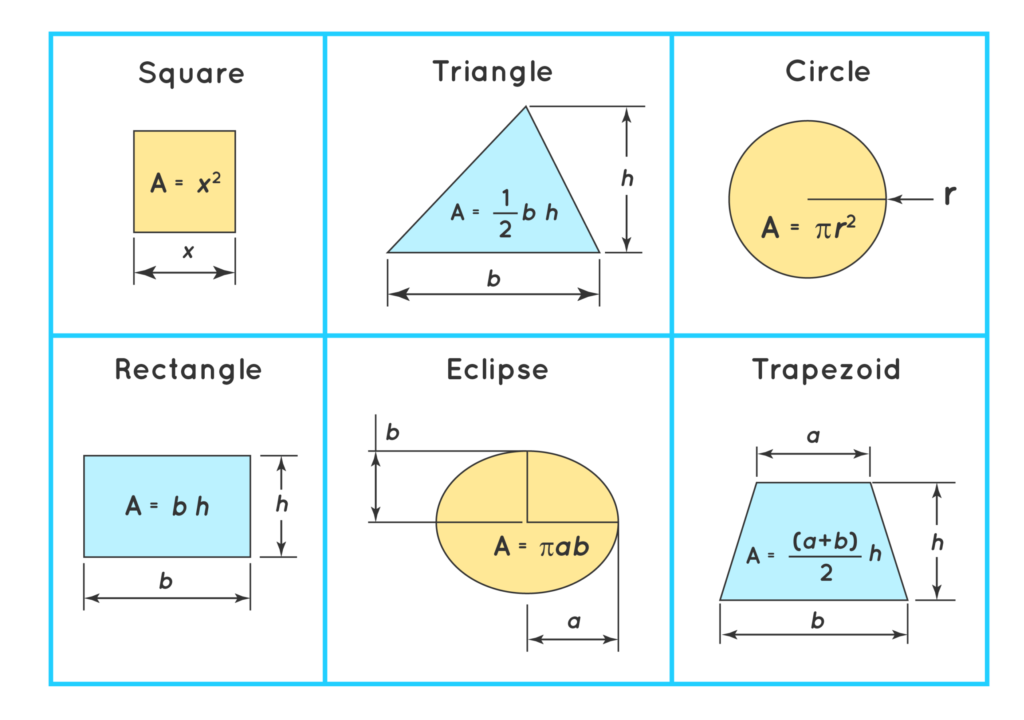
A basic geometry formulas cheat sheet is a useful learning resource for students who need quick access to important equations. It places essential formulas in a simple format, allowing learners to review important concepts before homework, quizzes, and exams. A well-designed cheat sheet can save time and make studying more organized.
A good cheat sheet usually contains formulas for area, perimeter, volume, surface area, and common shapes. Many students prefer a basic geometry formulas PDF because it can be stored digitally or printed whenever needed. Having a reliable reference guide makes it easier to refresh knowledge and solve problems with confidence.
However, using a formula sheet should always be combined with practice. Students should understand what each formula represents and learn how to apply it correctly. Memorization alone is not enough; understanding the purpose behind each equation leads to better long-term learning.
Basic Geometry Formulas with Examples and Diagrams
Examples and diagrams make geometry concepts easier to understand because they show how formulas work in real situations. Instead of only remembering equations, students can see how measurements are connected and how each step leads to the final answer. This approach improves both understanding and problem-solving skills.
For example, finding the area of a rectangle requires multiplying length by width. Calculating the circumference of a circle requires using the radius value in the correct formula. Finding the volume of a cylinder involves understanding the relationship between the circular base and height. These examples show how formulas are applied in practical calculations.
A basic geometry formulas chart with clear diagrams can support visual learning. Labels showing sides, angles, radius, and height allow students to identify important information before solving problems. This combination of formulas and visuals makes geometry easier for beginners.
How to Remember Basic Geometry Formulas Easily
Remembering geometry formulas becomes easier when students understand the ideas behind each equation. Instead of memorizing formulas without meaning, learners should connect them with shapes, diagrams, and real-world examples. Understanding why a formula works helps students recall it more effectively during problem-solving.
Regular practice is one of the best ways to improve formula knowledge. Students can solve different types of geometry problems, review mistakes, and use a basic geometry formulas sheet during revision. Repetition helps strengthen memory and increases confidence when working with complex questions.
Another useful method is organizing formulas into categories. Keeping area formulas, perimeter formulas, and volume formulas together makes them easier to find and remember. A structured approach allows students to build a complete understanding of geometry concepts.
Real-Life Applications of Basic Geometry Formulas
Geometry formulas are used in many industries and everyday situations. Architects use them to design buildings, engineers use them to create structures, and designers use them to calculate dimensions and measurements. Even simple activities like arranging furniture, measuring spaces, and planning construction projects require geometry knowledge.
Understanding basic geometry formulas helps people make accurate decisions involving size, distance, and space. These mathematical skills are valuable because they connect classroom learning with real-world applications. Students who master geometry formulas gain useful problem-solving abilities that can benefit them in future careers.
Conclusion: Mastering Basic Geometry Formulas for Better Learning
Basic geometry formulas provide students with the essential tools needed to understand shapes, measurements, and mathematical relationships. From calculating simple areas and perimeters to solving advanced volume problems, these formulas create a strong foundation for geometry learning.
Using resources like a basic geometry formulas PDF, cheat sheet, chart, or formula sheet can make studying more convenient and effective. With regular practice and a clear understanding of each equation, students can improve their confidence, solve problems more accurately, and develop valuable mathematical skills.
Frequently Asked Questions
What are the basic geometry formulas?
Basic geometry formulas are equations used to calculate measurements such as area, perimeter, volume, surface area, and angles for different geometric shapes.
Why should students learn basic geometry formulas?
Students should learn these formulas because they help solve mathematical problems quickly and provide a foundation for advanced mathematics and practical applications.
What is included in a basic geometry formulas list?
A basic geometry formulas list includes equations for common shapes such as squares, rectangles, triangles, circles, cubes, cylinders, and spheres.
What are the basic geometry formulas for triangles and circles?
Triangle formulas include area, perimeter, and Pythagorean theorem calculations, while circle formulas include area and circumference measurements.
How does a basic geometry formulas cheat sheet help?A cheat sheet provides quick access to important equations and helps students revise formulas efficiently before tests and assignments.
Can basic geometry formulas be used in real life?
Yes, geometry formulas are used in construction, architecture, engineering, design, and many everyday measurement activities.
You May Also Read: Geometry Formulas Sheet