
Geometry is one of the most valuable areas of mathematics because it helps explain the structure, size, and relationships between different objects around us. From simple shapes like squares and circles to complex three-dimensional figures, geometry provides methods for measuring and analyzing space. Learning all geometry formulas allows students to solve mathematical problems with accuracy while developing essential problem-solving skills that are useful in academics and real-life applications.
All geometry formulas serve as a complete collection of mathematical equations used to calculate important measurements such as area, perimeter, volume, surface area, angles, and distances. These formulas are especially useful for students preparing for school examinations, standardized tests, and competitive exams. A proper understanding of formulas helps learners avoid mistakes, improve calculation speed, and create a strong foundation for advanced mathematical concepts.
What Are Geometry Formulas and Why Do They Matter?
Geometry formulas are mathematical expressions that show the relationship between different parts of a shape or figure. They help determine unknown measurements by using known values such as length, width, height, radius, or angles. Instead of manually calculating every step, formulas provide a simple and organized way to solve geometry problems quickly and effectively.
Students often use resources like a list of all geometry formulas PDF because these guides collect important equations in one convenient location. A well-organized formula reference allows learners to review important concepts before exams and complete assignments more confidently. Understanding the purpose behind each formula is more beneficial than memorizing equations without knowing how they work.
All Geometry Formulas for Two-Dimensional Shapes
Two-dimensional shapes are flat figures that contain length and width but do not have depth. These shapes form the foundation of geometry because students usually begin learning formulas with basic figures such as squares, rectangles, triangles, circles, and polygons. Each shape has specific formulas used to calculate measurements like area and perimeter.
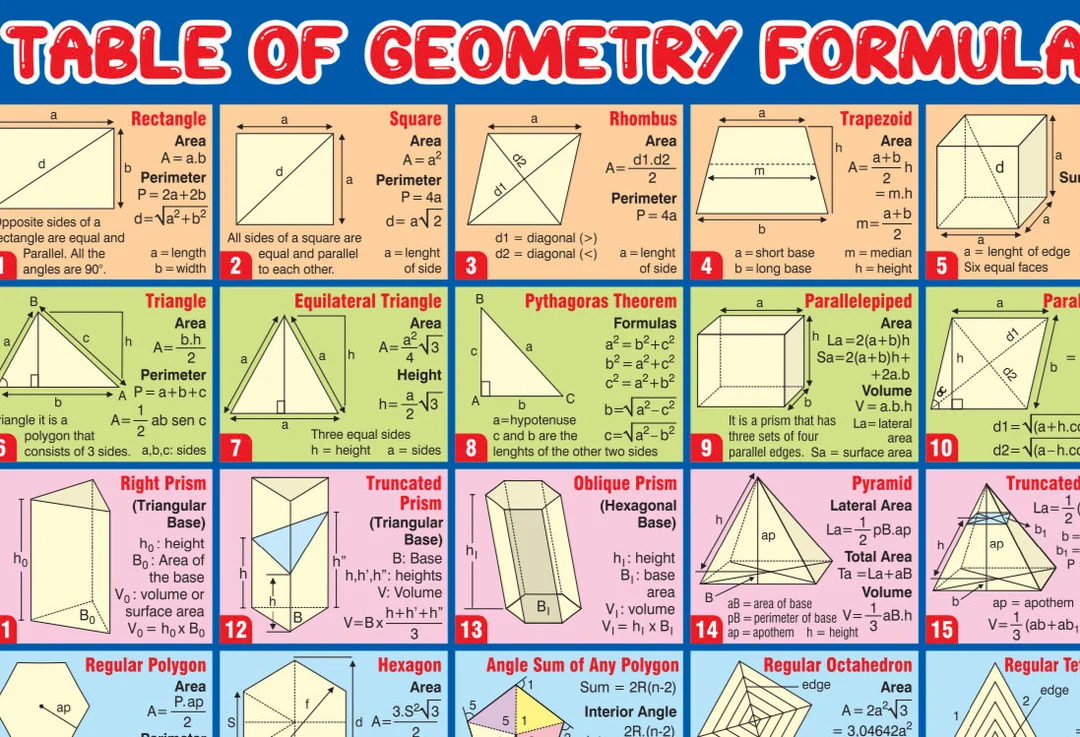
Square formulas help find the area and perimeter by using the length of its sides. Rectangle formulas use length and width measurements to determine the total area and boundary. Triangle formulas involve base, height, and side measurements, while circle formulas focus on radius, diameter, circumference, and area. Learning these concepts helps students understand how different shapes can be measured accurately.
A complete collection of all geometry formulas makes it easier to compare different equations and identify which formula is needed for a specific problem. These formulas are not only important for classroom learning but also useful in practical fields where measurements and calculations are required.
All Geometry Formulas for Triangles, Circles, and Polygons
Triangles are among the most important shapes in geometry because they appear in many mathematical problems and real-world structures. Different types of triangles, including right triangles, equilateral triangles, and isosceles triangles, require specific approaches for solving problems. Important triangle formulas include area, perimeter, and the Pythagorean theorem, which helps calculate unknown side lengths.
Circles also have unique formulas that are widely used in geometry. The circumference formula helps calculate the distance around a circle, while the area formula determines the space inside it. Understanding radius and diameter relationships is essential for solving circle-related problems. These formulas are commonly applied in engineering, architecture, design, and everyday measurements.
Polygons such as parallelograms, trapezoids, and rhombuses also have their own formulas. A complete geometry formula guide includes these equations to help students understand different shapes and their properties. Combining formulas with diagrams makes learning easier and improves visual understanding.
All Geometry Formulas for Area, Perimeter, and Volume Calculations
Area, perimeter, and volume are three major topics included in geometry studies. Area measures the amount of space inside a two-dimensional shape, while perimeter measures the total distance around the outside edge. Volume measures the space occupied by three-dimensional objects and is commonly used with solid figures.
Area formulas are required for calculating the size of different flat shapes, including rectangles, triangles, circles, and parallelograms. Perimeter formulas help determine boundaries, which is useful in applications such as fencing land or measuring borders. Volume formulas are used for objects like boxes, containers, cylinders, and spheres.
Having access to all geometry formulas helps students quickly select the correct equation for each calculation. Many learners use geometry formula charts and printable references to improve their revision process. Understanding when to apply area, perimeter, or volume formulas is an important skill for mastering geometry.
All Geometry Formulas for Three-Dimensional Shapes
Three-dimensional shapes have length, width, and height, making them different from flat figures. These solid shapes include cubes, rectangular prisms, cylinders, cones, and spheres. Learning their formulas allows students to calculate volume and surface area, which are important concepts in advanced geometry.
Cube formulas are used to find surface area and volume by using side measurements. Rectangular prism formulas involve length, width, and height values. Cylinder formulas require radius and height, while cone and sphere formulas involve more advanced calculations related to curved surfaces and three-dimensional space.
All geometry formulas PDF resources often include diagrams of these solid figures to make calculations easier. Visual representations help students understand how measurements connect with formulas. This approach improves learning because students can see the relationship between the shape and the equation being used.
All Geometry Formulas and Important Theorems
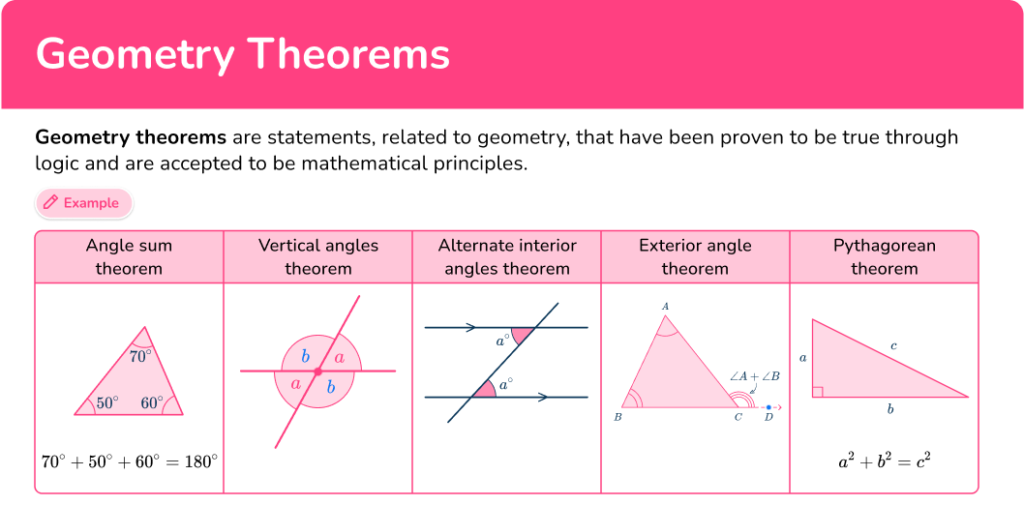
Geometry is not only based on formulas but also includes important theorems that explain relationships between shapes and measurements. Theorems provide logical explanations for why certain formulas work and help students solve more complex problems. Understanding both formulas and theorems creates a complete geometry learning experience.
The Pythagorean theorem is one of the most famous geometry concepts and explains the relationship between the sides of a right triangle. Other important theorems include triangle congruence rules, similarity principles, angle relationships, and circle theorems. These concepts are commonly tested in school examinations and competitive assessments.
Students preparing for advanced mathematics often study all geometry formulas and theorems together. Combining these resources helps learners understand not only how to calculate answers but also why specific mathematical rules are valid.
All Geometry Formulas for SAT and Competitive Exam Preparation
Geometry formulas play a major role in standardized tests such as the SAT and various competitive examinations. These tests often include questions involving triangles, circles, coordinate geometry, area, perimeter, and volume. Students who know important formulas can solve questions faster and manage their exam time more effectively.
For SAT preparation, learners should focus on commonly tested formulas involving basic shapes, coordinate systems, and measurement calculations. Competitive exams such as SSC CGL also require strong formula knowledge because questions often involve quick calculations and problem-solving strategies.
Using all geometry formulas PDF guides for exam preparation can help students review important concepts efficiently. Regular practice with sample problems, combined with formula revision, improves accuracy and builds confidence before important tests.
All Geometry Formulas PDF and Printable Formula Guides
Many students prefer using PDF guides and printable formula sheets because they provide easy access to important information. A complete geometry formula PDF can include equations, diagrams, examples, and explanations that support effective learning. These resources are useful for classroom study, homework, and exam preparation.
A printable list of all geometry formulas PDF allows students to keep a physical reference while studying. Organized formula sheets save time because learners do not need to search through multiple textbooks or notes to find specific equations.
A high-quality formula guide should be simple, accurate, and easy to understand. Including diagrams and examples makes the learning process more engaging and helps students apply formulas correctly.
How to Learn and Remember Geometry Formulas Easily
Learning geometry formulas requires understanding, practice, and consistency. Students should focus on the meaning behind each formula instead of only memorizing equations. Connecting formulas with diagrams and real-world examples makes concepts easier to remember and apply.
Regular practice is one of the most effective ways to improve geometry skills. Solving different types of problems helps students recognize patterns and understand when to use specific formulas. Reviewing formula sheets regularly also strengthens memory and increases confidence.
Organizing formulas into categories, such as shapes, area, perimeter, and volume, makes studying more efficient. With proper practice and understanding, students can master even complex geometry concepts.
Real-Life Applications of Geometry Formulas
Geometry formulas are used in many professional fields and everyday activities. Architects use them to design buildings, engineers apply them when creating structures, and designers use measurements to develop accurate products. These formulas help professionals calculate dimensions, materials, and spaces effectively.
In daily life, geometry is involved in activities such as measuring rooms, planning layouts, creating artwork, and calculating distances. Understanding formulas allows people to make accurate decisions involving size and space.
Learning geometry creates valuable skills that extend beyond mathematics. The ability to analyze shapes, calculate measurements, and solve problems is useful in education, careers, and everyday situations.
Conclusion: Mastering All Geometry Formulas for Better Results
All geometry formulas provide students with the essential knowledge needed to understand shapes, measurements, and mathematical relationships. From simple two-dimensional figures to advanced three-dimensional objects, these formulas create the foundation for successful geometry learning.
Using resources such as formula sheets, printable guides, and PDF references makes studying easier and more organized. By practicing regularly and understanding the purpose of each equation, students can improve their confidence, accuracy, and overall mathematical performance.
Frequently Asked Questions
What are all geometry formulas?
All geometry formulas are mathematical equations used to calculate measurements such as area, perimeter, volume, surface area, angles, and distances for different shapes.
Why are geometry formulas important?
Geometry formulas help students solve problems faster, understand shape relationships, and build strong mathematical skills for advanced learning.
What is included in a list of all geometry formulas PDF?
A geometry formulas PDF usually includes formulas for 2D shapes, 3D shapes, theorems, examples, and diagrams.
Which geometry formulas are important for SAT exams?
SAT geometry questions commonly involve formulas for triangles, circles, area, perimeter, volume, and coordinate geometry.
How can students remember all geometry formulas?
Students can remember formulas by practicing regularly, using diagrams, organizing notes, and reviewing formula sheets frequently.
Are geometry formulas used in real life?
Yes, geometry formulas are widely used in architecture, engineering, construction, design, and many everyday measurement tasks.
You May Also Read: Basic Geometry Formulas