
A ball held above the ground, a stretched rubber band, a charged battery, and water stored behind a dam all share something important: they contain energy waiting to be released. Although these objects may appear still, they hold the ability to create movement or perform work when conditions change. This hidden power has fascinated scientists for centuries and remains one of the most important concepts in physics, engineering, and modern technology.
Many students first encounter the question what is potential energy when learning how objects move, but the concept reaches far beyond classrooms. From renewable energy systems to space exploration, stored energy plays a major role in how humans design machines, generate electricity, and understand the natural world.
Understanding the Basic Meaning of Potential Energy
To understand what is potential energy, it is important to first understand that energy exists in different forms. Potential energy refers to stored energy that an object or system has because of its position, arrangement, or condition. Unlike kinetic energy, which is associated with motion, potential energy represents the possibility of future movement or change.
A simple example is a book placed on a high shelf. While the book is resting, it is not moving, but gravity gives it the ability to fall and transfer energy. The higher the book is lifted, the greater its gravitational potential energy becomes because more work has been done against gravity.
Scientists describe energy as the ability to do work, and potential energy is one way that energy can be stored until it is transformed into another form. This transformation is visible everywhere, from a roller coaster moving down a track to a spring releasing its stored force.
The concept is based on the relationship between objects and forces acting on them. Potential energy is not just stored inside an object alone; it often exists because of interactions between objects, such as the relationship between Earth and a falling object or between charged particles in an electric field.
The Science Behind How Potential Energy Works
The scientific explanation of what is potential energy involves the idea of stored energy within a system. When a force changes the position or arrangement of an object, energy can be stored. When the object returns to a different position or condition, that stored energy can be released and converted into motion or another energy form.
In physics, potential energy is often connected with conservative forces, such as gravity, elastic forces, and electrical forces. These forces allow energy to be stored and recovered depending on changes in position or configuration. The standard unit used to measure energy is the joule (J), named after physicist James Prescott Joule.
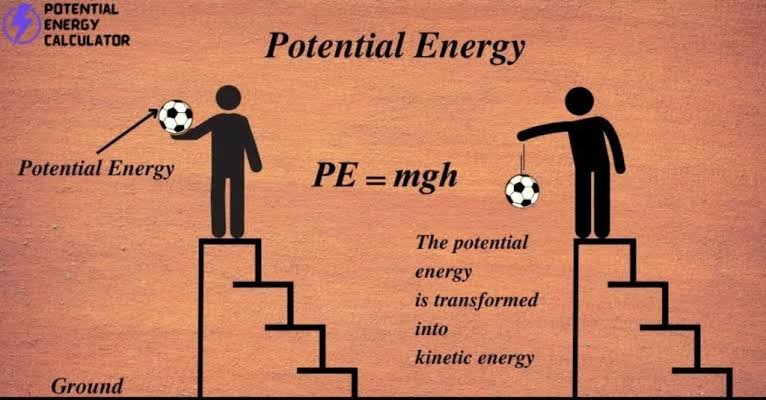
One of the most common formulas is gravitational potential energy:
PE = mgh
where “m” represents mass, “g” represents gravitational acceleration, and “h” represents height. This formula explains why heavier objects or objects placed higher above the ground have more stored gravitational energy.
However, potential energy is not limited to gravity. Scientists also study elastic potential energy, chemical potential energy, electrical potential energy, and nuclear potential energy. Each type describes a different way energy can be stored and later transformed.
Different Types of Potential Energy Explained
One major type is gravitational potential energy. This occurs when an object has stored energy because of its position in a gravitational field. A waterfall, a lifted elevator, and a satellite orbiting Earth all involve gravitational energy. Hydroelectric power plants use this principle by storing water at higher elevations and converting its energy into electricity.
Another important form is elastic potential energy. This energy appears when materials are stretched, compressed, or deformed. A compressed spring, stretched bowstring, or pulled rubber band stores energy that can later produce movement. When released, the stored energy changes into kinetic energy, causing the object to move.
Chemical potential energy is another example found in everyday life. Fuels, food, and batteries contain energy stored within chemical bonds. When gasoline burns or a battery powers a device, chemical energy transforms into heat, electrical energy, or mechanical movement.
Electrical potential energy involves charged particles and their positions within electric fields. Modern electronics, capacitors, and electrical systems depend on controlled storage and release of this type of energy.
Potential Energy vs Kinetic Energy: Understanding the Difference
A common question connected with what is potential energy is how it differs from kinetic energy. The simplest difference is that potential energy is stored energy, while kinetic energy is energy associated with movement.
Imagine a roller coaster at the highest point of a track. Before it begins moving, the coaster has maximum gravitational potential energy. As it travels downward, that stored energy gradually converts into kinetic energy, creating speed and motion.
This relationship between potential and kinetic energy demonstrates the law of conservation of energy. Energy does not disappear; instead, it changes from one form to another. A moving object can lose kinetic energy while gaining potential energy, or the opposite can occur depending on the situation.
For example, when a person throws a ball upward, the ball’s kinetic energy decreases as it rises while gravitational potential energy increases. When the ball falls back down, potential energy transforms into kinetic energy again.
Understanding this energy conversion helps engineers design safer vehicles, efficient machines, and renewable energy technologies.
Everyday Examples of Potential Energy Around Us
Many people interact with potential energy daily without realizing it. A stretched trampoline, a loaded spring, a raised hammer, and a full water tank all demonstrate stored energy waiting for a change.
A simple example is a bow and arrow. When an archer pulls back the string, energy from the person’s muscles is transferred into the flexible bow. The bent bow stores elastic potential energy. When released, that energy becomes kinetic energy, sending the arrow forward.
Another familiar example is a battery-powered device. A smartphone battery stores chemical potential energy. When the phone is switched on, chemical reactions release energy that becomes electrical energy and powers the device.
Even food contains chemical potential energy. The human body converts energy stored in nutrients into movement, heat, and biological processes. Every step, heartbeat, and physical activity depends on energy transformations.
These examples show why studying stored energy is not only important for physics but also for understanding biology, technology, and daily life.
The Role of Potential Energy in Modern Technology

Modern industries depend heavily on understanding stored energy. Engineers use principles of potential energy when designing bridges, elevators, machines, vehicles, and energy storage systems.
Renewable energy is one area where potential energy has become increasingly important. Hydroelectric power relies on gravitational energy stored in elevated water reservoirs. Pumped-storage hydroelectric facilities store electricity by moving water uphill during periods of low demand and releasing it later to generate power.
Energy storage has become a major focus as countries transition toward renewable sources such as solar and wind power. Since these sources can produce electricity at inconsistent times, storing energy efficiently is essential for creating reliable power networks.
Scientists and engineers are also exploring advanced battery technologies, mechanical storage systems, and other solutions that depend on controlled energy storage. The future of clean energy will require better ways to capture and release stored energy.
Historical Development of the Potential Energy Concept
The scientific understanding of energy developed over centuries. Early philosophers discussed ideas related to possibility and change, but modern energy concepts emerged through developments in physics and engineering.
The term “potential energy” became widely associated with 19th-century physics, particularly through scientists studying mechanics and thermodynamics. William Rankine is credited with introducing the term in the 1850s as scientists developed clearer distinctions between stored energy and motion-related energy.
The development of energy conservation principles changed science forever. Researchers discovered that although energy could transform between different forms, the total amount of energy in a closed system remained constant.
Today, potential energy remains a foundation of physics education and scientific research. It connects classical mechanics with modern fields such as quantum physics, engineering, and renewable technology.
Why Learning Potential Energy Matters for the Future
Understanding what is potential energy is becoming increasingly important as society faces challenges related to energy production and sustainability. Future technologies will depend on efficient methods of storing and using energy.
Electric vehicles, smart grids, renewable power systems, and advanced robotics all require improved energy management. Engineers must understand how energy can be stored, transferred, and converted to create efficient solutions.
Education researchers continue developing new ways to teach energy concepts because students often find invisible forces and stored energy difficult to visualize. Interactive simulations, laboratory experiments, and digital learning tools are making physics concepts easier to understand.
As technology advances, the principles behind potential energy will continue influencing innovation. From powering homes to exploring space, stored energy remains a key part of human progress.
Practical Ways to Understand and Observe Potential Energy
The easiest way to understand what is potential energy is through simple experiments and observations. Students and curious learners can explore energy storage through everyday objects.
Dropping objects from different heights demonstrates gravitational potential energy. Stretching different materials shows how elastic energy changes depending on the amount of deformation. Charging and using a battery reveals how chemical energy can become electrical energy.
Observing these examples helps connect scientific formulas with real-world experiences. Physics becomes easier to understand when people recognize that energy concepts are not limited to textbooks but appear in almost every activity.
For professionals, understanding potential energy supports better decisions in engineering, construction, environmental planning, and technology development.
Key Takeaways
- Potential energy is stored energy caused by an object’s position, condition, or arrangement.
- It can transform into kinetic energy or other energy forms.
- Major types include gravitational, elastic, chemical, electrical, and nuclear potential energy.
- The joule (J) is the standard unit used to measure energy.
- Renewable energy systems rely on principles of energy storage and transformation.
- Understanding stored energy helps explain everyday objects and advanced technologies.
Conclusion
The answer to what is potential energy reveals one of the most fascinating ideas in science: objects that appear inactive can still contain the ability to create change. A raised object, stretched material, or charged battery represents stored possibilities waiting for the right conditions.
From simple classroom demonstrations to global energy systems, potential energy influences how the world works. It explains movement, powers technology, and supports future innovations in sustainability and engineering.
As energy challenges become more complex, understanding these fundamental principles will become even more valuable. Continue exploring physics concepts, energy technologies, and scientific discoveries to better understand the invisible forces shaping our world.
Frequently Asked Questions
What is potential energy?
Potential energy is stored energy that exists because of an object’s position, condition, or arrangement.
What is the formula for gravitational potential energy?
The formula is PE = mgh, where mass, gravity, and height determine stored energy.
How is potential energy different from kinetic energy?
Potential energy is stored energy, while kinetic energy is the energy of motion.
What are the main types of potential energy?
The main types include gravitational, elastic, chemical, electrical, and nuclear potential energy.
Can potential energy be converted into kinetic energy?
stored energy can transform into motion when conditions allow energy release.
Why is potential energy important?
Potential energy helps explain natural processes, machines, technology, and modern energy systems.
You May Also Read: Trieste Italy