

K words are English words that begin with the letter K, one of the most recognizable consonants in the alphabet. They appear throughout everyday conversations, books, school lessons, games, and professional writing. Familiar examples include key, kid, kind, king, kitchen, and knowledge. Learning these words by category gives students a practical way to expand vocabulary while becoming more comfortable with spelling, pronunciation, reading, and sentence building.
The letter K can create some interesting spelling patterns in English. In words such as kite, kitten, and kitchen, its sound is clearly pronounced. However, the K becomes silent in words such as knee, knife, knight, and know. Exploring K words therefore teaches more than vocabulary alone. It introduces learners to pronunciation patterns, silent letters, word meanings, grammar, and the many unusual ways English spelling has developed over time.
Common K Words With Meanings
Common K words are a useful starting point because learners are likely to see or hear them regularly. Words such as keep, key, kid, kind, king, kitchen, knee, and know appear in ordinary communication. Learning familiar vocabulary first makes it easier to understand sentences and recognize words while reading. Students can then gradually move toward less familiar terms without feeling overwhelmed by a long collection of difficult vocabulary.
Meaning is just as important as spelling. For example, kind can describe someone who is caring or considerate, while keep can mean to retain or continue something. Keen can describe strong interest or sharp ability, and knowledge refers to information or understanding gained through learning or experience. Studying definitions alongside examples helps learners understand how individual K words function naturally rather than simply memorizing disconnected terms.
| K Word | Simple Meaning | Example |
| Key | Something used to open a lock | I found the key. |
| Kind | Friendly and caring | She is kind to everyone. |
| Keep | To continue to have something | Keep your ticket. |
| King | A male monarch | The king entered the hall. |
| Kitchen | A room used for preparing food | Dinner is in the kitchen. |
| Know | To understand or be aware of something | I know the answer. |
| Keen | Eager or strongly interested | He is keen to learn. |
| Knowledge | Information and understanding | Reading builds knowledge. |
K Words for Kids
Young learners often remember vocabulary more easily when words connect with familiar objects, animals, and actions. Kid-friendly examples include kangaroo, kitten, koala, kite, key, kettle, king, and kitchen. A child can connect these terms with pictures or real objects, making vocabulary practice more engaging. Parents and teachers can also introduce each word through short sentences so children learn both its spelling and its practical meaning.
Games can make K words for kids even easier to remember. Children can draw a kite, identify a key, imitate a kangaroo, or find objects beginning with K around the classroom. Flashcards, matching activities, alphabet books, and simple word searches can reinforce the same vocabulary without making practice repetitive. Combining sounds, pictures, movement, and writing gives early learners several ways to recognize and remember new words.
Short Words That Start With K
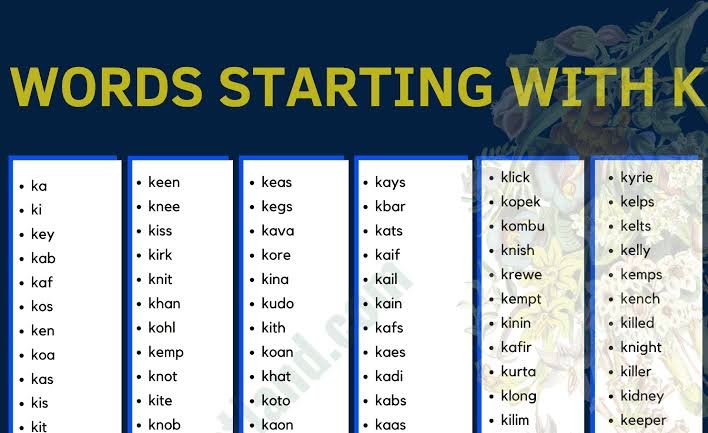
Short words beginning with K are particularly useful for spelling practice and word games. Examples include ka, key, kid, kin, kit, keg, ken, king, keen, keep, kick, and kite. Because these words contain relatively few letters, learners can concentrate on recognizing sounds and spelling patterns. Short vocabulary is also helpful for children who are beginning to create complete sentences independently.
Not every short word has a simple meaning, so vocabulary should be selected according to the learner’s level. Key, kid, kit, kick, king, and kite are generally easier for beginners because they describe familiar things or actions. Terms such as kin and ken may require additional explanation. Grouping short K words by length can make them easier to study while supporting spelling, reading, and vocabulary development.
Long Words That Start With K
Longer vocabulary beginning with K can help students move beyond basic everyday English. Knowledge, knowledgeable, kindergarten, kaleidoscope, keyboard, kilobyte, kinesiology, kleptomania, and keratinization are examples with different levels of difficulty. Some belong to everyday language, while others appear mainly in academic or technical contexts. Understanding longer words can strengthen reading comprehension because students become better prepared to recognize unfamiliar terms in more advanced material.
Breaking a long word into smaller parts can make it easier to learn. Kindergarten, for example, can be practiced in syllables instead of memorized as one long sequence of letters. Learners can use a similar method with kaleidoscope and kinesiology. Pronouncing a word, reading its definition, writing it several times, and using it naturally in a sentence can turn unfamiliar vocabulary into something much easier to remember.
K Nouns, Verbs, and Adjectives
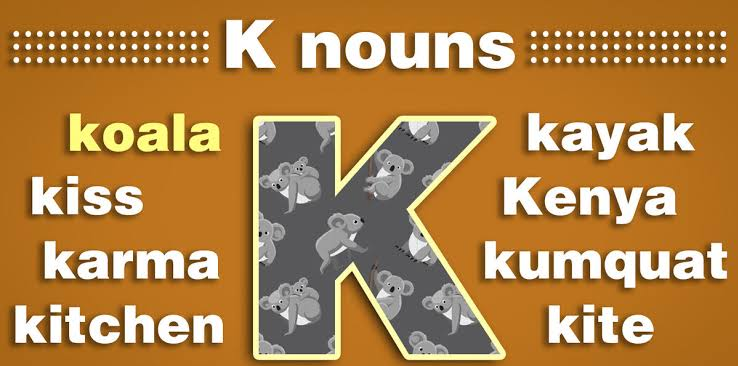
K words can perform different grammatical jobs depending on how they appear in a sentence. Nouns beginning with K include key, keyboard, kettle, kid, king, kitchen, kitten, knee, knife, koala, and knowledge. These words identify people, animals, objects, body parts, places, or ideas. Recognizing nouns helps learners understand sentence structure and provides useful vocabulary for describing the people and things around them.
Several useful verbs and adjectives also begin with K. Keep, kick, kiss, kneel, knit, knock, and know can function as verbs describing actions or states. Adjectives include keen, kind, kindly, kinetic, known, kooky, and knowledgeable. Sorting vocabulary by part of speech encourages learners to understand how words work instead of memorizing lists. It also makes creating accurate and varied sentences considerably easier.
| Category | Examples |
| K Nouns | Key, king, kitchen, kitten, keyboard, knowledge |
| K Verbs | Keep, kick, kiss, kneel, knit, knock, know |
| K Adjectives | Keen, kind, kinetic, kooky, knowledgeable |
Positive K Words
Positive vocabulary can make descriptions more expressive and encouraging. Kind is probably one of the most familiar positive words beginning with K because it describes someone who treats others with care and consideration. Knowledgeable describes someone who understands a subject well, while keen can communicate enthusiasm or strong interest. Kindly, kindhearted, and knowing can also carry positive meanings when they are used in the right context.
These positive K words can be useful in compliments, school assignments, personal descriptions, professional writing, and motivational messages. A teacher might describe a student as keen and knowledgeable, while a friend might be called kindhearted. Learning descriptive vocabulary gives writers alternatives to repeatedly using broad words such as good or nice. As vocabulary grows, descriptions can become more precise, interesting, and meaningful.
Silent K Words
Silent K words are among the most interesting vocabulary groups in English. In many words beginning with the letter combination kn, the K is written but not spoken. Familiar examples include knee, kneel, knife, knight, knit, knob, knock, knot, know, and knowledge. A learner hearing these words for the first time may not realize that their written forms begin with K, which can make spelling challenging.
The easiest way to master silent K vocabulary is to recognize the recurring kn pattern. Instead of trying to pronounce every written letter, learners can remember that the initial K is usually silent in these familiar words. Reading the terms aloud, copying them, and placing them into sentences can strengthen recognition. This practice is especially valuable for English learners because it connects pronunciation with spelling rather than treating them as separate skills.
K Words by Length
Organizing vocabulary by word length provides another convenient learning method. Three-letter options include key, kid, kin, and kit. Four-letter examples include keen, keep, kick, kind, king, kite, kiwi, knee, knit, knob, knot, and know. Five-letter terms include kayak, kebab, khaki, kiosk, kitty, knack, kneel, knife, knock, known, and koala. These groups can be useful for spelling activities and word puzzles.
Longer terms create opportunities to develop more advanced vocabulary. Keyboard, kilogram, kilometer, kindness, kingdom, kneecap, knuckle, knowledge, kangaroo, kerosene, kindergarten, kaleidoscope, and knowledgeable all begin with K but differ greatly in meaning and complexity. Studying vocabulary according to length can help students progress gradually from familiar short terms toward longer words while also making large word collections easier to navigate.
K Words for Vocabulary Games and Learning
Vocabulary games provide an entertaining way to practice K words without relying entirely on memorization. Learners can create word searches, play matching games, complete crosswords, or challenge themselves to name an animal, object, action, and adjective beginning with K. Classroom teams can also compete to create correct sentences using selected vocabulary. These activities encourage students to recall meanings while simultaneously practicing spelling and grammar.
Creative writing offers another useful learning method. Students might write a short story containing a king, kitten, kite, key, and kangaroo or create sentences using keep, kind, and know. Word-game players can also study vocabulary by length when preparing for letter-based puzzles. The goal should be more than collecting unusual terms; learners gain the greatest benefit when they understand what each word means and how it is actually used.
How to Learn and Remember K Words
Learning a large vocabulary list becomes easier when words are divided into manageable groups. Instead of trying to memorize hundreds of terms at once, learners can begin with common nouns, then move to verbs, adjectives, positive vocabulary, silent-letter words, and longer terms. Reviewing a small group regularly gives the brain repeated exposure and makes it easier to transfer new vocabulary from short-term recognition into long-term memory.
Using new vocabulary actively is equally important. Write each new word in a sentence, say it aloud, identify its part of speech, and connect it with a picture or familiar situation. Learners can keep a personal vocabulary notebook and revisit difficult terms each week. This method turns a large collection of K words into practical language knowledge that can improve reading, spelling, speaking, and writing over time.
Conclusion
K words range from extremely simple terms such as key and kid to advanced vocabulary such as knowledge, kinesiology, and kaleidoscope. Learning these words by meaning, length, grammar category, and pronunciation gives students a more organized approach to vocabulary development. It also reveals interesting features of English, particularly the silent K found in words such as knife, knight, knee, knock, and know.
A long list can provide plenty of vocabulary choices, but regular practice is what makes those words useful. Readers can start with familiar terms, learn their meanings, and gradually explore more challenging vocabulary. Using new words in conversations, sentences, games, and writing exercises strengthens memory and builds confidence. With consistent practice, words that start with K can become a valuable part of a broader and more expressive English vocabulary.
FAQs
What are some common K words?
Common examples include key, keep, kid, kind, king, kitchen, kite, know, knee, and knowledge. These words appear regularly in everyday English.
What are easy K words for kids?
Easy choices include key, kid, kite, king, kitten, koala, kangaroo, kick, and kitchen. Pictures and simple sentences can make them easier to learn.
What are positive words that start with K?
Kind, kindhearted, knowledgeable, keen, and kindly are useful positive terms. They can describe good qualities, attitudes, or behaviors.
What are some silent K words?
Common examples include knee, knife, knight, knit, knock, knot, know, and knowledge. The initial K is written but not pronounced.
What are some five-letter words starting with K?
Examples include kayak, kebab, khaki, kiosk, kitty, knack, kneel, knife, knock, known, and koala.
You May Also Read: Semilunar Valves