


The meaning of haber is an important topic for Spanish learners because this verb appears in many everyday conversations, grammar lessons, and written texts. In Spanish, haber is a unique and essential verb that does not always translate directly into English. Depending on the context, it can mean “to have” when used as an auxiliary verb or “there is” and “there are” when describing the existence of something. Understanding its different roles helps learners communicate more naturally and accurately.
Many beginners find haber confusing because English uses the verb “to have” mainly for possession, while Spanish separates this idea into different verbs. Haber is mostly used for forming compound tenses, expressing existence, and creating important phrases. Learning the meaning of haber allows students to understand Spanish sentence structures more easily and recognise how native speakers use this versatile verb in real situations.
The Basic Meaning of Haber and Why It Is Important
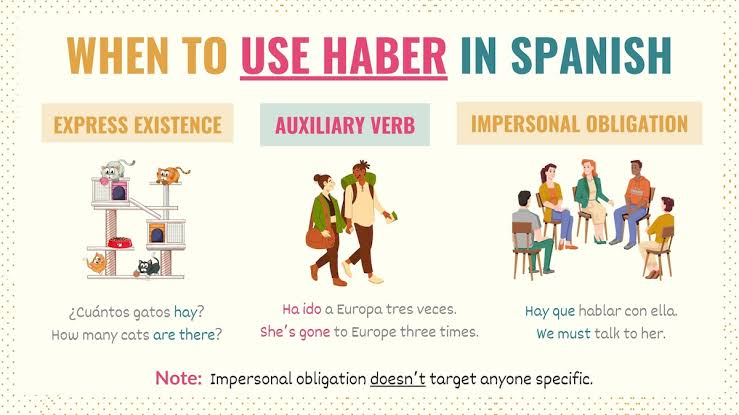
The meaning of haber changes according to how it appears in a sentence. As one of the most frequently used Spanish verbs, haber plays a major role in grammar and communication. When used as an auxiliary verb, it helps create perfect tenses, allowing speakers to describe actions that have already happened. When used in its impersonal form, it explains that something exists or is available in a particular place or situation.
Understanding haber is essential because it appears in many levels of Spanish, from beginner conversations to advanced writing. Students who learn this verb early often find it easier to understand more complex grammar concepts later. Whether reading a Spanish article, watching a film, or having a conversation, recognising haber helps learners understand the meaning behind many common expressions and sentence structures.
How Haber Is Used as an Auxiliary Verb
One of the main uses of haber is as an auxiliary verb that helps create compound tenses in Spanish. In this role, haber works together with a past participle to show that an action has been completed. For example, the sentence “He hablado” means “I have spoken,” where he is a form of haber and hablado is the past participle of hablar. This structure is similar to the English present perfect tense.
Spanish learners often encounter forms such as he, has, ha, hemos, and han when studying haber. These forms change depending on the subject of the sentence, but they all serve the same purpose of helping describe completed actions. Learning how these forms work makes it easier to understand conversations, books, and other Spanish materials where compound tenses are commonly used.
Using Haber to Express Existence in Spanish
Another important part of the meaning of haber is its use for expressing existence. In this situation, haber is not translated as “to have” but instead means “there is” or “there are.” The most common example is hay, which is used when talking about people, objects, places, or situations that exist. Unlike many Spanish verbs, hay does not change between singular and plural subjects.
For example, “Hay una casa cerca” means “There is a house nearby,” while “Hay muchas tiendas aquí” means “There are many shops here.” This use of haber is extremely common in everyday Spanish because people frequently describe what exists around them. Learning this form helps beginners create simple and useful sentences from the early stages of their language journey.
Understanding Haber Conjugation and Different Forms
Haber is considered an irregular Spanish verb, which means its conjugations do not always follow normal patterns. Learning its different forms is important because each variation has a specific purpose. In the present tense, common forms include he, has, ha, hemos, habéis, and han. These forms are mainly used for creating perfect tenses with past participles.
Other forms of haber appear in different tenses and situations. For example, había can mean “there was” or “there were,” while habrá can mean “there will be.” Advanced learners may also encounter forms used in the subjunctive mood and conditional structures. Understanding these conjugations improves reading comprehension and helps speakers express ideas more clearly in Spanish.
Common Spanish Expressions That Use Haber
Many useful Spanish expressions include forms of haber, making this verb important for daily communication. One of the most common expressions is “hay que,” which means “it is necessary to” or “one must.” For example, “Hay que trabajar” means “It is necessary to work” or “You must work.” This phrase is frequently used when giving advice, explaining responsibilities, or discussing general rules.
Another common expression is “ha habido,” which means “there has been” or “there have been.” Native Spanish speakers use this phrase when talking about events, changes, or experiences. Learning these expressions helps students understand natural Spanish because many phrases cannot be translated word-for-word. Recognising these patterns makes the meaning of haber much easier to understand in real conversations.
Difference Between Haber and Tener in Spanish
Many Spanish learners confuse haber and tener because both can sometimes relate to the English idea of “having.” However, these verbs have different purposes and should not be used interchangeably. Tener is mainly used to show possession, personal conditions, age, and physical states, while haber is used for grammar structures and describing existence.
For example, “Tengo un perro” means “I have a dog,” because it shows ownership. In contrast, “He visto un perro” means “I have seen a dog,” where haber helps form the perfect tense. Understanding this difference is one of the most important steps for avoiding mistakes. Once learners understand when to use each verb, their Spanish sentences become more accurate and natural.
Common Mistakes When Learning Haber
Because haber has multiple meanings and uses, learners often make mistakes when first studying it. One common error is using haber to describe possession, such as saying something similar to “I have a car” with haber instead of tener. Another mistake is confusing forms like hay, ha, and han because they look similar but perform different grammatical functions.
The best way to avoid these mistakes is through regular practice and exposure to authentic Spanish. Reading, listening, and creating example sentences can help learners recognise how haber works naturally. Instead of memorising only definitions, students should focus on understanding the context where each form appears. This approach makes the meaning of haber easier to remember and apply correctly.
Tips for Mastering Haber in Spanish Learning
Mastering haber requires patience, practice, and consistent exposure to Spanish. Learners should focus on common sentence patterns rather than trying to memorise every rule at once. Practising phrases such as “hay,” “he hecho,” and “ha sido” can help students become familiar with how native speakers use this important verb.
Using Spanish learning resources, watching Spanish videos, and practising conversations are effective ways to improve understanding. Over time, learners begin to recognise haber automatically and understand its meaning from context. Since haber appears so frequently, gaining confidence with this verb can greatly improve overall Spanish speaking, writing, and comprehension skills.
Conclusion
The meaning of haber is an essential part of learning Spanish because this verb appears in many important grammar structures and everyday expressions. Although it can seem complicated at first, understanding its main uses makes Spanish much easier to learn. Haber can function as an auxiliary verb, express existence, and create useful phrases that appear throughout the language.
By learning its conjugations, practising examples, and understanding the difference between haber and tener, students can develop stronger Spanish skills. This powerful verb connects many parts of Spanish grammar, making it a key element for anyone who wants to communicate confidently and accurately.
Frequently Asked Questions
What does haber mean in English?
Haber can mean “to have” as an auxiliary verb or “there is/there are” when expressing existence.
What is the main use of haber in Spanish?
Haber is mainly used to form compound tenses and describe the existence of something.
What is the difference between haber and tener?
Haber is used for grammar and existence, while tener is used for possession and personal conditions.
What does hay mean in Spanish?
Hay is a form of haber that means “there is” or “there are.”
Is haber an irregular Spanish verb?
Yes, haber is an irregular verb with unique conjugation forms used in different tenses.
You May Also Read: Hakuna Matata What Does It Mean