

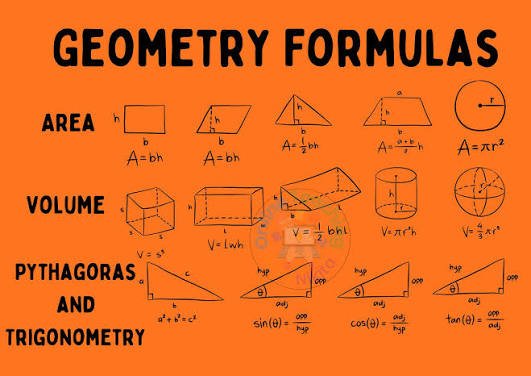
Geometry is an essential branch of mathematics that helps people understand the structure, measurement, and relationship between different shapes and objects. From calculating the area of a room to designing buildings and analyzing engineering models, geometry plays an important role in everyday life. Learning important geometry formulas allows students to solve mathematical problems more efficiently by providing clear methods for finding measurements, distances, angles, and other geometric values.
A strong understanding of geometry formulas helps students build confidence in mathematics and improves their ability to approach complex problems. These formulas are not only useful for classroom learning but also for standardized tests, competitive exams, and professional fields that require mathematical skills. By studying formulas with examples and practical applications, learners can understand how different geometric concepts connect and how calculations are performed accurately.
Understanding the Foundation of Geometry Before Using Formulas
Before learning different equations, students should understand the basic concepts that form the foundation of geometry. Geometry focuses on points, lines, angles, surfaces, and shapes. It is divided into two major categories: two-dimensional geometry, which studies flat figures with length and width, and three-dimensional geometry, which examines solid objects with length, width, and height.
Important geometry formulas become easier to understand when students know basic terms such as radius, diameter, perimeter, area, circumference, surface area, and volume. These measurements represent different properties of shapes and help determine which formula should be used. Instead of simply memorizing equations, students should focus on understanding how each formula relates to the characteristics of a specific shape.
Important Geometry Formulas for 2D Shapes and Plane Geometry
Two-dimensional geometry includes flat shapes that are commonly found in mathematics problems. These figures have only length and width, making them easier to visualize and measure. Common 2D shapes include squares, rectangles, triangles, circles, parallelograms, trapezoids, and polygons. Each shape has specific formulas that help calculate its area, perimeter, and other properties.
The important geometry formulas for 2D shapes provide the foundation for solving many academic problems. For example, the area of a square is calculated by multiplying its side length by itself, while its perimeter is found by adding all four sides. Rectangles use length and width measurements to calculate area and perimeter. Learning these basic equations helps students develop the skills needed for more advanced geometry topics.
Triangle and Circle Formulas Every Student Should Know
Triangles are one of the most widely used shapes in geometry because they appear in many mathematical concepts and real-world designs. Students learn different types of triangles, including right triangles, equilateral triangles, isosceles triangles, and scalene triangles. The area of a triangle is calculated using the formula ½ × base × height, while the Pythagorean theorem helps determine missing sides in right triangle problems.
Circles are another important part of geometry because they involve unique measurements and calculations. The area of a circle is calculated using πr², where r represents the radius. The circumference formula, which can be written as 2πr or πd, determines the distance around the circle. Understanding circle properties such as radius, diameter, arcs, and sectors allows students to solve a wide range of geometry problems.
Most Important Geometry Formulas for Quadrilaterals and Polygons
Quadrilaterals and polygons are important geometric figures that appear frequently in school mathematics and practical applications. Quadrilaterals include shapes such as squares, rectangles, parallelograms, trapezoids, and rhombuses. Each shape has unique properties and formulas that allow students to calculate measurements accurately based on given information.
Among the most important geometry formulas are those used for finding the area and perimeter of quadrilaterals and polygons. For example, the area of a parallelogram is calculated by multiplying the base by the height, while the trapezoid area formula uses the sum of parallel sides and height. Polygon formulas also help determine angles and side relationships, making them valuable for advanced geometry studies.
Important Geometry Formulas for 3D Shapes and Solid Geometry
Three-dimensional geometry focuses on solid objects that have depth along with length and width. These shapes are important because they help calculate the amount of space an object occupies and the area of its outer surface. Common 3D shapes include cubes, rectangular prisms, cylinders, cones, and spheres. Their formulas are widely used in mathematics, science, architecture, and engineering.
The important geometry formulas for solid shapes help students calculate volume and surface area effectively. The volume of a cube is found by using side³, while a rectangular prism uses length × width × height. Cylinders use the formula πr²h for volume, and spheres use formulas involving radius to calculate volume and surface area. Understanding these equations makes three-dimensional geometry easier to solve.
Geometry Formulas for Angles, Lines, and Theorems
Geometry is not only about calculating measurements of shapes but also understanding relationships between lines and angles. Students need to learn concepts such as complementary angles, supplementary angles, vertical angles, and angles created by parallel lines. These concepts help solve geometry problems where certain values must be determined using logical relationships.
The study of important geometry formulas also includes major theorems that support advanced problem-solving. The Pythagorean theorem is essential for finding unknown sides of right triangles, while coordinate geometry uses formulas such as distance and midpoint equations. These concepts connect geometry with algebra and allow students to solve problems involving graphs, coordinates, and measurements.
All Important Geometry Formulas Students Should Learn

A complete understanding of geometry requires knowledge of formulas from different areas of the subject. Students should learn equations related to areas, perimeters, circumferences, volumes, surface areas, angles, and coordinate geometry. Organizing these formulas into categories makes studying easier and helps learners remember important information during exams.
All important geometry formulas are valuable resources for students preparing for mathematics tests and academic assessments. A well-organized formula sheet can provide quick revision and help students identify the correct equation for each problem. However, formulas become truly useful when students understand their applications and practice solving different examples regularly.
Using Geometry Formulas With Examples for Better Learning
Examples are one of the best ways to understand how geometry formulas work in practical situations. Instead of only memorizing equations, students should practice applying formulas to different problems. This helps them understand how to identify important information, select the correct formula, substitute values, and complete calculations properly.
For instance, when calculating the area of a triangle, students need to identify the correct base and height values before using the formula. Similarly, volume problems require careful understanding of measurements for three-dimensional objects. Practicing examples regularly improves problem-solving skills and helps students apply formulas confidently in exams and real-life situations.
Common Mistakes When Applying Geometry Formulas
Many students experience difficulties with geometry because they make small mistakes while applying formulas. Common errors include confusing area and perimeter, using diameter instead of radius, forgetting units, or selecting an incorrect formula for a specific shape. These mistakes can affect the final answer even when students understand the general concept.
To reduce errors, students should carefully read each problem and identify the information provided before starting calculations. Drawing diagrams, labeling measurements, and reviewing answers can improve accuracy. Consistent practice with different types of geometry questions helps students recognize patterns and use formulas correctly.
Tips to Memorize Geometry Formulas More Effectively
Memorizing geometry formulas becomes easier when students use organized learning strategies. Creating formula charts, practicing regularly, and grouping similar equations together can improve memory. Students can organize formulas into categories such as shape formulas, area formulas, volume formulas, and theorem-based equations for easier revision.
Visual learning is especially useful in geometry because diagrams help students connect formulas with actual shapes. By understanding why a formula works and how it applies to different situations, learners can remember information for longer periods. A combination of practice, understanding, and regular review helps students master geometry successfully.
Conclusion
Geometry formulas provide the foundation for solving problems involving shapes, measurements, angles, and spaces. From basic two-dimensional figures to complex three-dimensional objects, these equations help students understand mathematical relationships and find accurate solutions. Learning formulas properly allows students to improve their skills and approach geometry problems with greater confidence.
Mastering important geometry formulas requires both knowledge and practice. Students should focus on understanding concepts, applying formulas through examples, and reviewing equations regularly. With the right learning approach, geometry becomes easier, more interesting, and more practical for academic success and future applications.
Frequently Asked Questions
What are important geometry formulas used for?
Important geometry formulas are used to calculate areas, perimeters, volumes, surface areas, distances, and angles of different shapes.
Which geometry formulas are most important for students?
Students should learn formulas for triangles, circles, rectangles, squares, polygons, and common 3D shapes.
How can students remember geometry formulas easily?
Students can remember formulas through regular practice, diagrams, formula charts, and solving examples.
Why are geometry formulas important in mathematics?
Geometry formulas help students solve problems faster and understand relationships between different shapes and measurements.
Are 2D and 3D geometry formulas different?
Yes, 2D formulas focus on flat shapes, while 3D formulas calculate volume and surface area of solid objects.
You May Also Read: List of All Geometry Formulas PDF