

Understanding the distance between two points is an important part of geometry, algebra, and coordinate mathematics. The distance formula provides a reliable way to calculate the straight-line measurement between two locations on a coordinate plane. Instead of counting units manually or drawing complicated diagrams, students can use a mathematical equation to determine the exact distance between two coordinate points. This concept is especially useful when working with geometric figures, coordinate graphs, and mathematical problems involving horizontal and vertical movement.
Whether you are learning coordinate geometry for the first time, preparing for a school examination, or improving your mathematical skills, understanding how the distance formula works can make calculations much easier. This guide explains the equation, its connection to the Pythagorean theorem, different calculation methods, practical examples, and real-world applications. You will also learn how to avoid common mistakes and recognize situations where calculating the distance between two points becomes useful.
What Is the Distance Formula?
The distance formula is a mathematical equation used to find the straight-line distance between two points on a coordinate plane. Each point is represented by an ordered pair containing an x-coordinate and a y-coordinate. By comparing these coordinates, the equation determines the horizontal and vertical differences between the locations and combines them to calculate their direct separation. The final result represents the shortest distance connecting the two points.
In coordinate geometry, this mathematical method is important because it allows students to calculate measurements without physically measuring a graph. For example, if two points are located at (2, 3) and (6, 6), their separation can be calculated using their coordinate values. The distance formula works with positive coordinates, negative coordinates, and points located in different quadrants, making it a flexible tool for solving many geometry problems.
What Is the Distance Formula Equation?
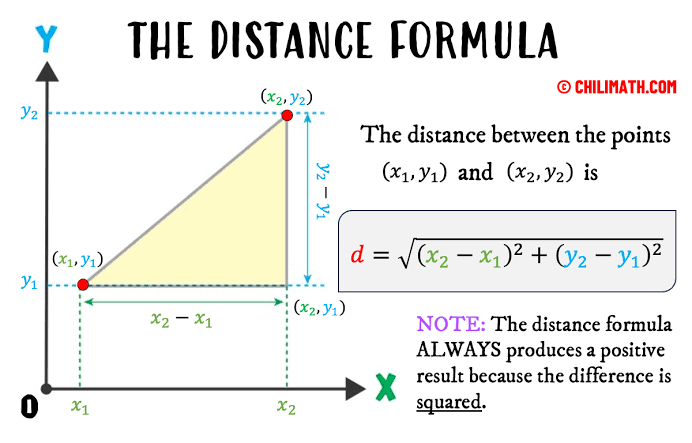
The standard distance formula calculates the separation between two points represented as (x₁, y₁) and (x₂, y₂). It uses the difference between their horizontal coordinates and vertical coordinates. Both differences are squared, added together, and placed under a square root to produce the final measurement. Understanding this structure makes it easier to substitute coordinate values correctly and solve mathematical problems.
The equation is:
[
d=\sqrt{(x_2-x_1)^2+(y_2-y_1)^2}
]
In this equation, d represents the distance between the two points. The symbols x₁ and x₂ represent their horizontal coordinates, while y₁ and y₂ represent their vertical coordinates. The equation combines both directions of movement to calculate the straight-line measurement. Since the differences are squared before addition, negative coordinate values do not create negative distance results.
Understanding Each Part of the Distance Formula
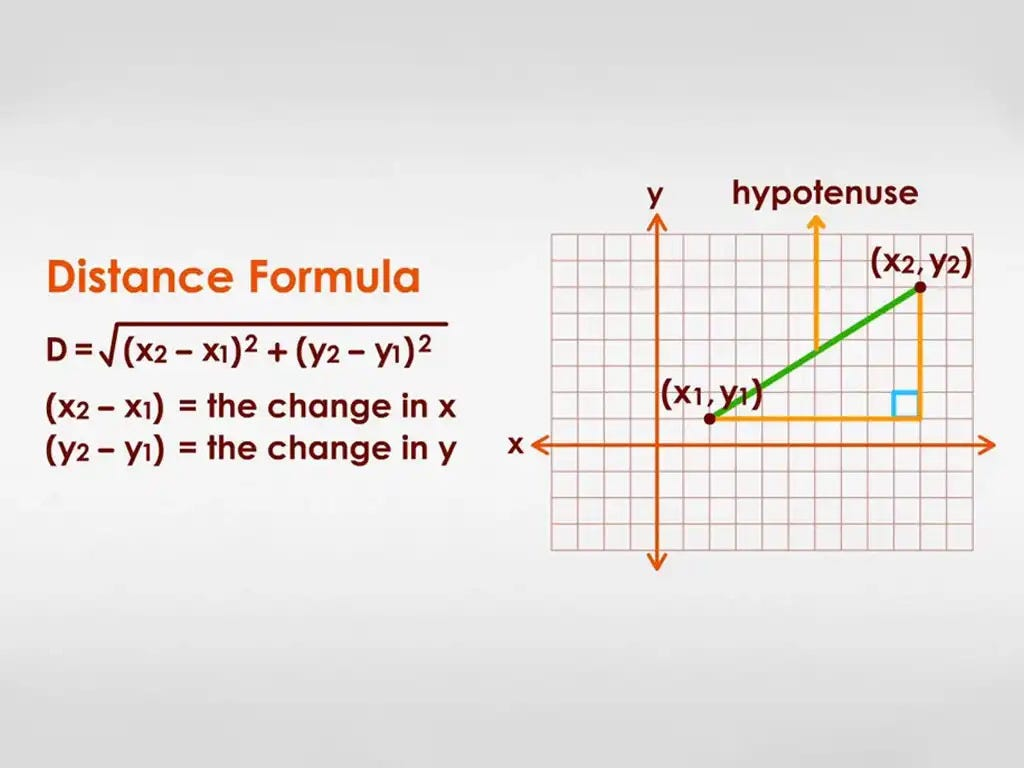
Every symbol in the equation has a specific purpose. The first coordinate pair identifies the location of one point, while the second pair identifies the location of another. Subtracting the x-coordinates determines the horizontal separation, and subtracting the y-coordinates determines the vertical separation. These two measurements represent the shorter sides of an imaginary right triangle connecting the original points.
Squaring both differences removes negative signs and prepares the values for the addition process. The square root then converts the combined squared measurements into the actual straight-line distance. When solving problems, it is important to keep each coordinate pair organized and substitute the correct values. This simple habit reduces calculation errors and makes the equation easier to understand, especially when working with negative numbers or complicated coordinate combinations.
Why Is the Distance Formula Based on the Pythagorean Theorem?
The Pythagorean theorem explains the relationship between the three sides of a right triangle. It states that the square of the hypotenuse equals the sum of the squares of the other two sides. This mathematical principle is commonly used in geometry to calculate unknown triangle measurements. The distance formula applies the same idea to coordinate points, allowing the direct separation between two locations to be calculated using their horizontal and vertical differences.
When two points are plotted on a coordinate plane, you can connect them using a straight diagonal line. Drawing an additional horizontal and vertical line creates a right triangle. The horizontal difference becomes one shorter side, the vertical difference becomes the other, and the diagonal represents the distance between the original points. Applying the Pythagorean theorem to this triangle produces the distance formula, making coordinate-based distance calculations possible without measuring the diagram manually.
How to Calculate Distance Between Two Points
Calculating the distance between two coordinate points becomes easier when you follow a consistent process. First, identify both ordered pairs and separate their horizontal and vertical values. Next, substitute those coordinates into the equation. Keeping the x-values together and the y-values together is important because mixing the coordinates can change the calculation and produce an incorrect answer.
After substitution, subtract the first coordinate from the corresponding second coordinate and square both differences. Add the squared results and calculate the square root of the total. The final value represents the straight-line distance between the points. If the question includes a measurement unit, such as inches, feet, or meters, include that unit in your final answer. Following these steps carefully makes the distance formula easier to apply to different mathematical problems.
Distance Formula Examples With Step-by-Step Solutions
Practical examples help students understand how the equation works with different coordinate values. Starting with simple positive numbers makes it easier to recognize the relationship between subtraction, squaring, addition, and square roots. Once these basic operations become familiar, learners can move toward more challenging problems involving negative coordinates, different quadrants, and decimal measurements.
The following examples demonstrate how to calculate distances in common coordinate geometry situations. Each problem uses the same mathematical principle, even though the coordinate values are different. Reviewing these calculations can help students understand how the equation produces accurate results and why the final answer represents the shortest straight-line separation between two points.
Finding Distance Between Two Points in the First Quadrant
Suppose you need to calculate the distance between point A (2, 3) and point B (6, 6). Both points are located in the first quadrant because their horizontal and vertical coordinates are positive. Begin by identifying the corresponding values and substituting them into the equation. The horizontal difference is 6 − 2, while the vertical difference is 6 − 3.
The calculation becomes:
[
d=\sqrt{(6-2)^2+(6-3)^2}
]
[
d=\sqrt{4^2+3^2}
]
[
d=\sqrt{16+9}
]
[
d=\sqrt{25}=5
]
Therefore, the distance between the two points is 5 units. This example demonstrates how the equation combines horizontal and vertical movement to determine a direct diagonal measurement. It is also a useful introduction to problems involving more complicated coordinate values.
Finding Distance Between Points in Different Quadrants
Coordinates do not always have positive values. Some points are located in the second, third, or fourth quadrant, where one or both coordinates may be negative. The same mathematical equation works in these situations, but students must pay attention to subtraction signs. Correctly handling negative values is important because subtracting a negative number produces a positive difference.
Consider point A (−2, 3) and point B (4, −5). Substituting the values gives the following calculation:
[
d=\sqrt{(4-(-2))^2+(-5-3)^2}
]
[
d=\sqrt{6^2+(-8)^2}
]
[
d=\sqrt{36+64}
]
[
d=\sqrt{100}=10
]
The distance between these points is 10 units. This example shows that negative coordinates do not change the basic calculation process. As long as the values are substituted correctly, the equation produces an accurate positive distance.
Finding Horizontal and Vertical Distance
Sometimes two points are positioned along the same horizontal or vertical line. In these situations, calculating their separation becomes simpler because one coordinate difference is zero. If both points share the same y-coordinate, they have no vertical separation. Their distance depends entirely on how far apart their x-coordinates are on the horizontal axis.
For example, consider the points (2, 4) and (8, 4). Their horizontal difference is 6, while their vertical difference is zero. Therefore, the distance between them is 6 units. Similarly, points (3, 2) and (3, 9) share the same x-coordinate, meaning their vertical separation is 7 units. These examples demonstrate how the general equation also works for horizontal and vertical measurements.
Finding Distance Between Two Points With Negative Coordinates
Working with two negative coordinate pairs can initially seem confusing because subtraction involves negative numbers. However, the calculation follows exactly the same process used with positive values. Identify the corresponding coordinates, subtract them carefully, square the differences, and calculate the square root after adding the results.
For example, consider point A (−3, −2) and point B (1, 1). The horizontal difference is 1 − (−3), which equals 4. The vertical difference is 1 − (−2), which equals 3. Squaring and adding these values produces 16 + 9 = 25. Taking the square root gives 5, so the distance between these two points is 5 units.
Finding Distance When the Answer Is a Radical
Not every coordinate calculation produces a whole-number result. Sometimes, the final square root cannot be simplified into an integer. In these situations, keeping the answer in radical form provides an exact value, while converting it into a decimal gives an approximation that may be useful for practical measurements.
Consider the points (1, 2) and (3, 5). Their horizontal difference is 2, and their vertical difference is 3. Squaring and adding produces 4 + 9 = 13. Therefore, the exact distance is √13 units, which is approximately 3.606 units. Understanding both forms helps students recognize when an exact radical answer is preferable and when a decimal approximation is appropriate.
How to Find Distance on a Coordinate Plane
A coordinate plane is a two-dimensional mathematical surface containing a horizontal x-axis and a vertical y-axis. The point where these axes intersect is called the origin, represented by (0, 0). Every location on the plane can be identified using an ordered pair. The first value describes the horizontal position, while the second indicates the vertical position relative to the origin.
To calculate a measurement visually, plot both coordinate points and connect them with a straight line. You can then draw horizontal and vertical lines to create a right triangle. The two shorter sides represent the coordinate differences, while the diagonal represents the direct separation. This visual approach helps students understand why the distance formula works and makes it easier to recognize the connection between coordinate geometry and right-triangle calculations.
What Is the Distance Formula in Three Dimensions?
The two-dimensional equation works with horizontal and vertical coordinates, but mathematical problems sometimes involve three-dimensional space. In three dimensions, every point has an additional z-coordinate representing depth. This makes it possible to describe positions using length, width, and depth rather than only horizontal and vertical movement.
The three-dimensional equation is:
[
d=\sqrt{(x_2-x_1)^2+(y_2-y_1)^2+(z_2-z_1)^2}
]
For example, consider point A (1, 2, 3) and point B (4, 6, 3). The horizontal difference is 3, the vertical difference is 4, and the depth difference is zero. Adding the squared differences produces 25, so the final measurement is 5 units. This extended equation is useful in engineering, physics, computer graphics, and other subjects involving spatial measurements.
Distance Formula vs. Other Mathematical Formulas
Coordinate geometry includes several equations that use ordered pairs to solve different mathematical problems. Although these formulas may look similar, each one measures a different property. Some calculate the length between two points, while others identify the middle location or describe the steepness of a line. Understanding their individual purposes helps students select the correct equation when solving geometry exercises.
The distance formula is particularly useful when the question asks how far apart two points are. However, it should not be confused with the midpoint or slope equations. Comparing these mathematical methods makes coordinate geometry easier to understand and helps learners recognize which calculation is needed for a particular problem.
Distance Formula vs. Pythagorean Theorem
The Pythagorean theorem calculates the relationship between the sides of a right triangle. Its equation is a² + b² = c², where a and b represent the shorter sides and c represents the hypotenuse. It is commonly used to determine an unknown side when the other two measurements are available.
The distance formula applies this same principle to coordinate points. Instead of using measured triangle sides, it calculates the horizontal and vertical differences directly from the ordered pairs. Both methods produce the same mathematical result when applied to the same right triangle. The main difference is that the coordinate-based equation makes it possible to calculate distance without first measuring or drawing the triangle accurately.
Distance Formula vs. Midpoint Formula
The midpoint formula identifies the exact center between two points on a coordinate plane. It calculates the average of the two x-coordinates and the average of the two y-coordinates. The resulting ordered pair represents a location that divides the line segment into two equal parts.
The distance formula measures the total straight-line length between those same points. Although both equations use identical coordinate information, they answer different questions. If you need to identify the center of a line segment, use the midpoint formula. If you need to calculate the length of the segment, use the distance formula instead.
Distance Formula vs. Slope Formula
The slope formula measures the steepness and direction of a line between two coordinate points. It uses the difference between the y-coordinates divided by the difference between the x-coordinates. The result describes how much a line rises or falls when moving horizontally from one point to another.
The distance formula measures the actual length separating the two points. Although both equations involve coordinate subtraction, their purposes are different. Slope describes the rate of vertical change compared with horizontal movement, whereas distance measures the straight-line separation. Learning to distinguish these concepts helps prevent confusion when working with coordinate graphs and algebraic equations.
Real-Life Applications of the Distance Formula
Mathematical distance calculations are useful in many areas beyond traditional classroom exercises. Coordinate systems allow people to describe locations, measure separation, and understand spatial relationships between different objects. These calculations support various activities involving design, technology, engineering, and scientific research.
The distance formula provides a mathematical foundation for understanding how coordinate positions relate to one another. Whenever two locations can be represented using points on a coordinate plane, their straight-line separation can be calculated. Although real-world systems may require additional measurements or more advanced mathematical models, the underlying concept remains valuable for understanding spatial distances.
Applications in Navigation and Mapping
Navigation systems use coordinate information to identify locations and analyze geographical positions. Digital maps represent places using spatial data, allowing users to explore routes, compare locations, and understand the separation between destinations. Coordinate-based calculations provide an important foundation for many mapping and geographical applications.
The distance formula can help explain straight-line measurements between two points represented on a flat coordinate plane. However, calculating the actual distance between distant locations on Earth’s surface generally requires methods that account for the planet’s curvature. Understanding this distinction helps students recognize both the usefulness and limitations of basic coordinate geometry in navigation.
Applications in Architecture and Engineering
Architects and engineers regularly work with coordinate measurements when designing buildings, bridges, and other structures. They need accurate measurements to determine the positions of components, compare dimensions, and understand how different parts of a design relate to one another. Mathematical calculations help maintain consistency throughout the planning and construction process.
The distance formula can support calculations involving points on technical drawings and coordinate-based layouts. For example, an engineer may use coordinate information to determine the separation between two structural locations. This approach provides a mathematical method for checking measurements and understanding geometric relationships before physical construction begins.
Applications in Computer Graphics and Gaming
Computer graphics systems use coordinates to represent the positions of objects, characters, and environments. Every object in a digital scene can have a specific location, allowing software to calculate relationships between different elements. These calculations are important for creating animations, realistic movements, interactive environments, and visual effects.
In video games, coordinate-based measurements can help determine whether a character is close enough to interact with another object. For example, software may calculate the separation between a player and a collectible item before triggering an action. These applications demonstrate how the distance formula supports the mathematical foundations of modern digital experiences.
Applications in Physics and Science
Scientists use coordinate systems to describe the positions of objects and understand their spatial relationships. Measurements between points can support experimental observations, geometric modeling, and calculations involving physical locations. Coordinate-based mathematics is particularly useful when objects need to be represented using numerical positions rather than physical drawings.
It is also important to distinguish distance from displacement in physics. Distance describes the total length of the path traveled, while displacement represents the straight-line change between an object’s starting and ending positions, including direction. The distance formula can help calculate the magnitude of displacement when the initial and final positions are represented by coordinates.
Common Mistakes to Avoid When Using the Distance Formula
One frequent mistake is mixing up the coordinates of the two points. Every ordered pair must remain organized so that the x-coordinates are compared with each other and the y-coordinates are compared separately. Incorrect substitution can change the calculation, especially when the problem includes negative numbers or coordinates located in different quadrants.
Another common error is forgetting to square both coordinate differences or leaving out the square root at the end. Students may also round decimal values too early, producing less accurate results. To avoid these problems, review every calculation carefully, check the final answer, and include the correct measurement unit whenever the original question provides one.
Tips for Learning and Practicing the Distance Formula
Regular practice is one of the most effective ways to become comfortable with coordinate geometry. Begin with simple problems involving positive coordinates, then gradually introduce negative numbers, different quadrants, and decimal measurements. Practicing different combinations helps students recognize mathematical patterns and understand how the equation works in various situations.
Drawing coordinate graphs can also make the learning process easier. Plot both points, identify their horizontal and vertical differences, and visualize the right triangle connecting them. After solving each problem manually, compare your result with a calculator to check for mistakes. Combining visual learning, mathematical practice, and answer verification can improve accuracy and build confidence for more advanced geometry and algebra topics.
Conclusion
The distance formula is an essential mathematical tool for calculating the straight-line distance between two points on a coordinate plane. Based on the Pythagorean theorem, it combines horizontal and vertical coordinate differences to determine the direct measurement between two locations. Understanding how the equation works makes it easier to solve geometry problems involving positive coordinates, negative values, different quadrants, and even three-dimensional space.
Learning this equation also provides a foundation for more advanced mathematical subjects and practical applications. From coordinate geometry and engineering to computer graphics and scientific research, distance calculations help explain the spatial relationships between objects and locations. With regular practice, accurate coordinate substitution, and a clear understanding of the calculation steps, students can solve distance problems confidently and apply these mathematical skills in different situations.
Frequently Asked Questions
What is the distance formula in simple words?
It is a mathematical equation used to calculate the straight-line distance between two points on a coordinate plane.
What is the formula for finding distance between two points?
The equation is d = √((x₂ − x₁)² + (y₂ − y₁)²).
Why is the distance formula based on the Pythagorean theorem?
Because the horizontal and vertical coordinate differences form the shorter sides of a right triangle, while the direct distance is its hypotenuse.
Can the distance formula be used with negative numbers?
Yes. It works with positive and negative coordinates as long as the values are substituted correctly.
What is the distance formula in three dimensions?
It calculates the distance between two points using their x-, y-, and z-coordinate differences.
You May Also Read: Fourier Transform Calculator