

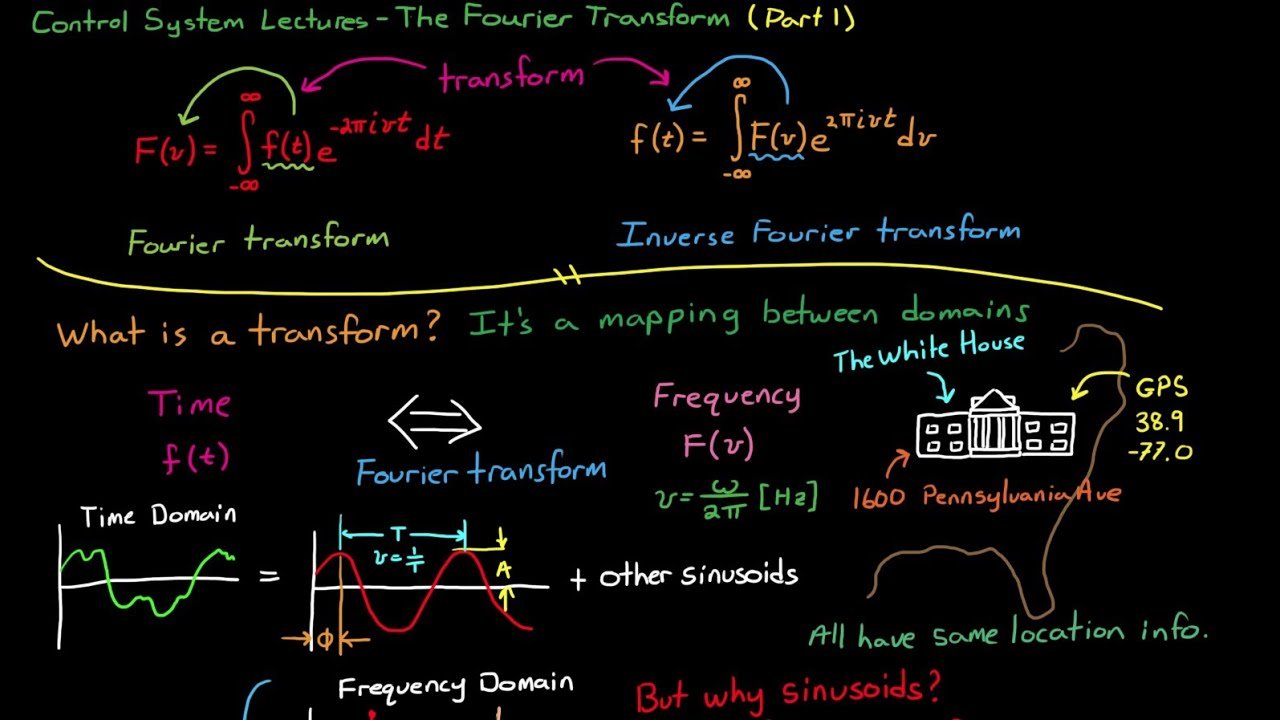
The Fourier transform is one of the most important mathematical techniques used in modern mathematics, engineering, physics, and digital signal processing. It provides a way to break down complicated signals into individual frequency components, making it easier to understand how different waves contribute to an original signal. From analyzing sound recordings to processing digital images, Fourier transformations help professionals examine information that may be difficult to understand through ordinary time-based measurements. An online Fourier Transform Calculator makes these mathematical operations more accessible by helping users calculate transformations without performing every complicated calculation manually.
Whether you are a student learning Fourier analysis, an engineer studying electrical signals, or a researcher working with numerical data, understanding these transformations can improve your mathematical and technical skills. A suitable calculator can help with forward Fourier transforms, inverse transformations, discrete Fourier transforms, and fast Fourier transform calculations. This guide explains the main equations, different transformation methods, practical examples, real-world applications, and common mistakes to help you understand how Fourier analysis works.
What Is a Fourier Transform?
A Fourier transform is a mathematical operation that converts a function or signal into a representation based on its frequency components. Instead of examining how a signal changes over time, it shows which frequencies contribute to the signal and how strongly they appear. This approach makes complicated waveforms easier to analyze because individual frequency components can be studied separately. It is especially useful when a signal contains several repeating patterns or overlapping waves.
For example, an audio recording may contain a person’s voice, background music, and environmental noise simultaneously. Fourier analysis can represent these combined sounds through their individual frequency components, helping audio engineers identify particular ranges and understand the signal’s structure. This mathematical technique is widely used in telecommunications, physics, electrical engineering, image processing, and scientific research because it provides valuable information about signals that may not be obvious in their original form.
What Is a Fourier Transform Calculator?
A Fourier Transform Calculator is an online mathematical tool designed to calculate Fourier transformations for supported functions and numerical signal data. Instead of manually performing complicated integration or repeated numerical operations, users can enter an expression or dataset and select the required transformation method. The calculator then processes the information and provides a mathematical result that describes the corresponding frequency representation.
Depending on its capabilities, the tool may support continuous Fourier transforms, inverse transformations, discrete Fourier transforms, and fast Fourier transforms. Some calculators also provide step-by-step mathematical explanations, graphs, and frequency spectrum visualizations. These features can help students understand difficult concepts while allowing engineers and researchers to check calculations more efficiently. Before using a particular tool, it is important to review its supported input formats and mathematical conventions because not every calculator offers the same functionality.
How to Use the Fourier Transform Calculator
Using a Fourier Transform Calculator generally begins with entering a mathematical function or a collection of numerical signal samples. The available input method depends on the calculator, as some tools accept symbolic equations while others require discrete data points. Once the information has been entered, select the appropriate transformation type, such as forward Fourier transform, inverse Fourier transform, DFT, or FFT. Choosing the correct option ensures that the calculator applies a suitable mathematical process to your input.
After selecting the required operation, click the Calculate button to generate the result. Depending on the tool, the output may include a mathematical expression, complex frequency values, a graph, or a frequency spectrum. Review the displayed information carefully to understand what each value represents. If step-by-step explanations are available, examine them to learn how the transformation was calculated rather than relying only on the final answer.
What Is the Fourier Transform Formula?
The continuous Fourier transform uses integration to represent a function through its frequency components. It converts a time-domain function into a frequency-domain expression using a complex exponential term. This mathematical relationship allows a signal to be analyzed according to its different frequencies instead of examining only how its values change over time. Understanding the equation is an important step toward learning advanced signal processing and Fourier analysis.
The standard continuous Fourier transform formula is:
[
F(\omega)=\int_{-\infty}^{\infty}f(t)e^{-i\omega t},dt
]
In this equation, (f(t)) represents the original time-domain function, while (F(\omega)) represents its frequency-domain transformation. The variable (t) describes time, and (\omega) represents angular frequency in radians per unit of time. The imaginary unit (i) and exponential expression help represent the frequency components while preserving information about their amplitude and phase.
Understanding the Main Components of the Fourier Transform Formula
The time-domain function describes how a signal changes over time, such as the movement of an electrical waveform or the changing amplitude of an audio recording. The frequency-domain function provides another way to examine the same information by showing how different frequencies contribute to the overall signal. Both representations describe the same underlying mathematical information, but each makes different signal characteristics easier to understand.
Angular frequency measures the rate of oscillation and is related to ordinary frequency through the relationship (\omega=2\pi f). The complex exponential combines sine and cosine behavior, allowing Fourier analysis to represent both magnitude and phase. Understanding these components helps users interpret mathematical results more accurately and recognize why Fourier transformations are useful in engineering, scientific measurement, and digital signal processing.
Types of Fourier Transforms
Fourier analysis includes several transformation methods designed for different mathematical functions and signal formats. Some methods work with continuous functions defined over time, while others process a limited collection of numerical samples. Each method provides a different approach to representing frequency information, so understanding their differences is important before selecting a calculation method or interpreting the results.
An online Fourier Transform Calculator may support several of these methods, depending on its mathematical capabilities. The most common types include continuous Fourier transforms, inverse Fourier transforms, discrete Fourier transforms, and fast Fourier transforms. Two-dimensional Fourier transformations are also important in applications involving images and spatial information. Learning how these methods work provides a strong foundation for understanding modern signal analysis.
Continuous Fourier Transform
The continuous Fourier transform is used to convert a continuous-time mathematical function into its frequency-domain representation. It works with functions that are defined over a continuous range of time values and generally uses integration to calculate their frequency components. This method is especially important in mathematical analysis because it provides the theoretical foundation for understanding how complicated signals can be represented through simpler frequency-based components.
Engineers and researchers use continuous Fourier analysis when studying mathematical waveforms, electrical signals, and physical systems. For example, a continuous signal may represent a changing voltage or an idealized sound wave. Examining its frequency representation can reveal important information about oscillations and repeating patterns. Learning this transformation helps students understand the mathematical principles behind more advanced techniques used in practical digital signal processing.
Inverse Fourier Transform
The inverse Fourier transform performs the reverse operation of the forward transformation. While the forward method converts a time-domain function into a frequency-domain representation, the inverse method uses frequency information to reconstruct the original time-domain function. This relationship is important because it allows mathematical and signal-processing operations to move between both representations without losing the ability to understand the original signal.
The inverse Fourier transform is commonly written as:
[
f(t)=\frac{1}{2\pi}\int_{-\infty}^{\infty}F(\omega)e^{i\omega t},d\omega
]
The equation uses the frequency-domain function (F(\omega)) to recover the original function (f(t)). It is useful in signal reconstruction, communication systems, and scientific calculations. Engineers may examine a signal in the frequency domain, modify selected components, and then apply an inverse transformation to obtain the corresponding time-domain result.
Discrete Fourier Transform (DFT)
The discrete Fourier transform is designed to process a finite sequence of numerical samples. Unlike continuous Fourier analysis, which works with functions defined over continuous intervals, the DFT operates on individual data points collected at specific sampling intervals. This makes it especially suitable for digital systems because computers typically store and process information as discrete numerical values rather than continuous mathematical functions.
The DFT equation is:
[
X[k]=\sum_{n=0}^{N-1}x[n]e^{-i2\pi kn/N}
]
Here, (x[n]) represents the input samples, (X[k]) represents the frequency-domain output, and (N) indicates the total number of samples. The index (k) identifies an individual frequency bin, while (n) represents a sample position. This transformation is commonly used in digital audio, communication systems, vibration analysis, and other applications involving sampled signals.
Fast Fourier Transform (FFT)
The fast Fourier transform is a family of efficient algorithms used to calculate the discrete Fourier transform. Although the DFT and FFT produce the same mathematical frequency information, FFT algorithms reduce the number of operations required for many input sizes. This improvement makes frequency calculations significantly faster, especially when working with large datasets containing hundreds, thousands, or millions of numerical samples.
FFT methods are important in applications where signals need to be analyzed quickly. Digital audio software, radar systems, communication technologies, and vibration monitoring equipment frequently use these algorithms. For example, an audio application may process a large collection of sound samples to identify different frequency components. Understanding FFT calculations helps explain how modern computers perform complex signal analysis efficiently.
Two-Dimensional Fourier Transform
The two-dimensional Fourier transform extends frequency analysis to functions that depend on two spatial variables. Instead of studying how a signal changes over time, it examines patterns across horizontal and vertical dimensions. This makes the method particularly useful for processing digital images, analyzing textures, and understanding spatial information in scientific and engineering applications.
In digital images, low spatial frequencies generally represent broad structures and gradual changes, while high spatial frequencies often represent sharp edges and fine details. Fourier analysis can help identify these components and support image filtering, enhancement, and certain compression techniques. Computer vision systems and medical imaging applications also use frequency-based mathematical methods to examine complex visual information.
Fourier Transform Examples With Step-by-Step Solutions
Practical examples make Fourier analysis easier to understand because they show how mathematical expressions are converted into frequency-domain representations. Starting with simple functions helps students become familiar with integration, exponential notation, and frequency variables before moving toward more advanced calculations. Reviewing examples also makes it easier to understand why different functions produce different frequency patterns.
A Fourier Transform Calculator can help verify calculations and explore supported mathematical expressions. However, the underlying process should still be understood because different inputs require different mathematical approaches. Students can compare manual solutions with calculator results to identify mistakes and develop stronger problem-solving skills. Engineers and researchers can also use examples to understand how mathematical transformations relate to real signal measurements.
Example: Fourier Transform of a Simple Function
Consider a mathematical function that describes a basic continuous signal. To calculate its Fourier transform, first identify the original function and substitute it into the continuous transformation equation. The next step involves simplifying the expression and evaluating the integral over the required limits. The resulting expression represents the original function through its frequency components.
The exact answer depends on the selected function and its mathematical properties. Some functions produce relatively simple frequency expressions, while others require more advanced integration techniques. This example demonstrates why calculus and complex-number notation are important when learning Fourier analysis. Understanding the relationship between an original function and its frequency representation makes more complicated transformations easier to approach.
Example: Inverse Fourier Transform
Suppose a mathematical problem provides a frequency-domain expression and asks you to recover the original signal. The inverse Fourier transform provides the necessary method for reconstructing the time-domain function. Begin by identifying the given frequency expression, substituting it into the inverse equation, and evaluating the integral using the appropriate mathematical rules.
After completing the calculation, the result represents the reconstructed signal in the time domain. This process is useful when frequency information has been analyzed or modified and needs to be converted back into a form that describes changes over time. It also demonstrates the relationship between forward and inverse transformations, which are complementary operations in Fourier analysis.
Example: Discrete Fourier Transform
Consider a digital signal containing four numerical samples represented by the sequence (x[n]=[1,0,-1,0]). The discrete Fourier transform processes these values to calculate their frequency-domain representation. Each output corresponds to a frequency bin, allowing the signal to be examined through its different frequency components rather than only through its original sample values.
For this sequence, the four-point DFT produces the values (X[k]=[0,2,0,2]). These results show that the signal contains nonzero components at specific frequency bins. This simple example illustrates how discrete data can be converted into frequency information and why the DFT is useful for analyzing sampled signals.
Example: Fast Fourier Transform
The FFT uses an efficient calculation strategy to determine the same frequency-domain values produced by the DFT. Many FFT algorithms divide a larger problem into smaller calculations and combine their results. This approach reduces computational complexity for suitable input sizes and makes the analysis of large collections of signal samples much faster.
For example, when an engineer analyzes a recording containing thousands of audio samples, calculating every DFT operation directly may require considerable processing time. An FFT algorithm can perform the same transformation more efficiently. This is why FFT methods are widely used in real-time audio analysis, communication systems, scientific instruments, and digital signal-processing software.
Fourier Transform Calculator vs. DFT and FFT Calculators
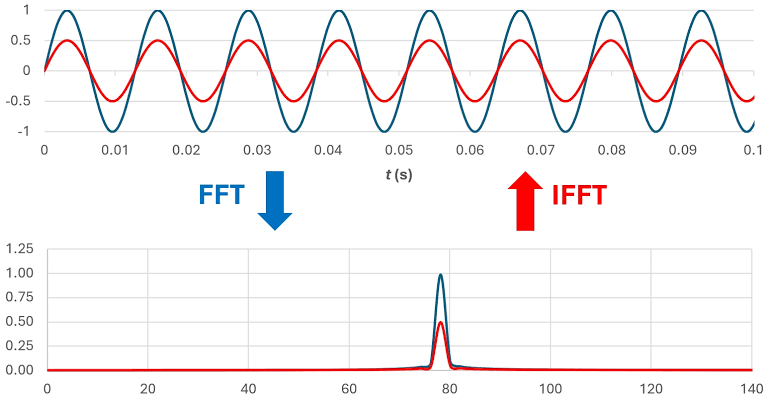
Different Fourier calculators are designed for different mathematical requirements. A continuous Fourier transform calculator generally works with symbolic functions and integration, while a DFT calculator processes a finite collection of numerical samples. An FFT calculator focuses on efficiently calculating the discrete Fourier transform using an appropriate fast algorithm. Understanding these differences helps users select the correct tool for their input.
The most suitable calculator depends on whether you are working with a continuous mathematical function or digital signal data. For theoretical mathematics, a continuous transform solver may be appropriate. For sampled information, a DFT or FFT tool is generally more useful. Checking the available input formats and supported output options before beginning a calculation can help prevent errors and produce more meaningful results.
Understanding Time Domain and Frequency Domain
The time domain represents how a signal changes over time. For example, an audio waveform displays changes in sound amplitude as a recording progresses. This representation is useful for identifying when events occur, observing changes in signal strength, and understanding the original behavior of a measured quantity. It provides a direct view of the signal as it changes from one moment to another.
The frequency domain describes a signal according to its frequency components. Instead of showing every change over time, it reveals which frequencies contribute to the overall signal and how strongly they appear. Comparing time-domain and frequency-domain representations helps engineers identify repeating patterns, analyze unwanted noise, and understand complex waveforms more effectively. Both representations are valuable because they provide different perspectives on the same signal.
Real-World Applications of Fourier Transform
Fourier transformations are used in many modern technologies because they provide an effective way to analyze complicated signals and mathematical functions. Engineers, scientists, researchers, and software developers use frequency information to examine data, improve communication systems, process images, and study physical measurements. These applications demonstrate that Fourier analysis is not limited to theoretical mathematics or classroom exercises.
A Fourier Transform Calculator can help students explore these applications by simplifying supported calculations and providing a convenient way to examine mathematical results. Although professional systems may require additional processing techniques, the underlying concept remains important across different industries. Understanding these applications also explains why Fourier transformations are a valuable part of engineering education, scientific research, and modern digital technology.
Signal Processing and Telecommunications
Telecommunication systems transmit information through electrical, radio, and digital signals. Fourier analysis helps engineers examine the frequencies contained in these signals, identify unwanted interference, and understand how information behaves during transmission. Frequency-based techniques are important for developing reliable communication systems and improving the quality of transmitted information.
Signal processing also uses Fourier transformations to develop filters that reduce unwanted noise or isolate selected frequency ranges. These techniques can improve signal clarity and help communication devices interpret information more accurately. From wireless networks to digital broadcasting, frequency analysis supports many technologies that allow information to move between devices and communication systems.
Audio and Music Processing
Audio signals contain different frequencies that contribute to the sounds people hear. Fourier analysis helps break these signals into frequency components, allowing sound engineers to study bass, midrange, treble, and other characteristics. This information is useful when editing recordings, adjusting equalizers, identifying unwanted noise, and improving the overall listening experience.
Music production software also uses frequency-based analysis to examine sound patterns and manage different audio elements. Speech-processing systems can analyze frequency information to support voice recognition, sound enhancement, and audio classification. These applications demonstrate how mathematical transformations help convert complicated sound recordings into information that can be examined, modified, and improved through digital technology.
Image Processing and Computer Vision
Digital images contain spatial information that can be analyzed using two-dimensional Fourier transformations. These methods help identify patterns, textures, edges, and different levels of visual detail. By examining spatial frequency components, researchers can develop techniques for image filtering, enhancement, and certain forms of image compression.
Computer vision systems also use mathematical image-processing methods to understand visual information. Fourier-based techniques can support noise reduction, pattern analysis, and the examination of image structures. Medical imaging and scientific photography are additional areas where frequency-based approaches can help researchers study complex visual data and improve the interpretation of collected images.
Physics and Engineering
Physics and engineering involve many problems related to waves, vibrations, and repeating signals. Fourier analysis helps describe these phenomena by identifying the frequencies that contribute to their behavior. Engineers can use this information to examine mechanical vibrations, electrical signals, and different wave patterns that occur in physical systems.
Electrical engineering applications include circuit analysis, communication systems, and frequency response measurements. In mechanical engineering, frequency analysis can help identify vibration patterns that may indicate equipment problems or unusual operating conditions. These examples show how mathematical transformations provide useful information for understanding complex systems, improving designs, and supporting accurate technical measurements.
Medical and Scientific Research
Scientific research frequently involves collecting signals that contain complex patterns and multiple frequencies. Fourier analysis helps researchers examine these measurements and identify important components that may not be immediately visible in the original data. It is useful in areas involving biological signals, experimental measurements, medical imaging, and physical research.
Magnetic resonance imaging, commonly known as MRI, relies on Fourier-based mathematical methods to reconstruct images from collected measurement data. Other scientific applications involve analyzing brain activity, electrical signals, and wave behavior. These examples demonstrate how frequency analysis supports research by transforming collected information into mathematical representations that can be studied and interpreted more effectively.
Benefits of Using an Online Fourier Transform Calculator
An online calculator can save time when solving complicated mathematical expressions or processing supported signal data. Instead of performing every integration or numerical operation manually, users can enter their information and obtain results more efficiently. This is especially useful when working with multiple transformation methods or comparing different mathematical functions.
Another important advantage is the opportunity to verify calculations and understand mathematical results. A Fourier Transform Calculator that provides step-by-step explanations can help students recognize how an answer is produced. Engineers and researchers can also use supported calculations to explore frequency behavior and check numerical results. These tools make Fourier analysis more accessible while preserving the importance of understanding the underlying mathematical principles.
Common Mistakes to Avoid When Using Fourier Transform
One common mistake is confusing the time domain with the frequency domain. The time domain describes how a signal changes over time, while the frequency domain explains its frequency components. Another mistake involves selecting an incorrect transformation method. Continuous functions and discrete signal samples require different mathematical approaches, so users should check their input type before starting a calculation.
Other errors include entering an incorrect function, overlooking sampling information, and misunderstanding complex-number outputs. Users should also distinguish ordinary frequency from angular frequency because the two measurements use different units. Reviewing input formats, checking mathematical conventions, and examining the final output carefully can help prevent mistakes and improve the reliability of Fourier calculations.
Tips for Learning Fourier Transform
Learning Fourier analysis becomes easier when you first understand its mathematical foundations. Begin by studying basic trigonometry, sine and cosine functions, complex numbers, and exponential notation. These subjects provide the knowledge needed to understand how different frequency components combine to represent a mathematical function or signal. A strong foundation also makes advanced integration and transformation problems less difficult.
Next, practice simple forward and inverse transformations before moving toward DFT and FFT calculations. Experiment with small numerical datasets and examine how changing the input affects the frequency output. Use calculator results to verify your manual work, but take time to understand the mathematical steps. Combining regular practice with practical examples can strengthen your knowledge and improve your confidence in signal processing.
Conclusion
Fourier transformations provide a powerful mathematical method for understanding how functions and signals can be represented through different frequency components. From continuous and inverse transformations to discrete Fourier transforms and fast Fourier algorithms, each method supports a different type of mathematical or signal-processing problem. Learning their differences helps students, engineers, and researchers select an appropriate approach for their calculations and understand the results more accurately.
A Fourier Transform Calculator makes these operations more accessible by simplifying supported calculations and helping users examine frequency-domain information. Whether you are studying mathematics, analyzing audio, processing digital signals, or exploring engineering applications, understanding Fourier analysis can improve your ability to interpret complex information. Combining mathematical knowledge with practical calculator use is an effective way to develop stronger skills in frequency analysis and digital signal processing.
Frequently Asked Questions
What is a Fourier Transform Calculator?
It is an online mathematical tool that calculates Fourier transformations for supported mathematical functions or numerical signal data.
What does a Fourier transform calculate?
It converts a function or signal from the time domain into a frequency-domain representation.
What is the difference between Fourier transform and inverse Fourier transform?
The forward transform converts time-domain information into frequency-domain information, while the inverse transform reconstructs the original time-domain function.
What is the difference between DFT and FFT?
DFT is a mathematical transformation for discrete samples, while FFT is an efficient algorithm used to calculate the DFT.
Can a Fourier transform calculator solve complex functions?
Some calculators support complex-valued functions and numerical data, depending on their mathematical features and supported input formats.
You May Also Read: Delta Math