

Finding the greatest common factor of two or more numbers is an essential mathematical skill that helps solve problems involving fractions, multiplication, division, and equal grouping. However, identifying common factors manually can become challenging when working with larger numbers or multiple values. A Greatest Common Factor Calculator makes these calculations easier by quickly identifying the largest number that divides all entered values without leaving a remainder.
Whether you are a student completing math homework, a teacher preparing classroom examples, or someone who needs to solve everyday mathematical problems, understanding the greatest common factor can save time and improve accuracy. With an online calculator, you can enter two or more numbers, receive an instant result, and use the calculation steps to understand how the answer was determined.
What Is a Greatest Common Factor (GCF)?
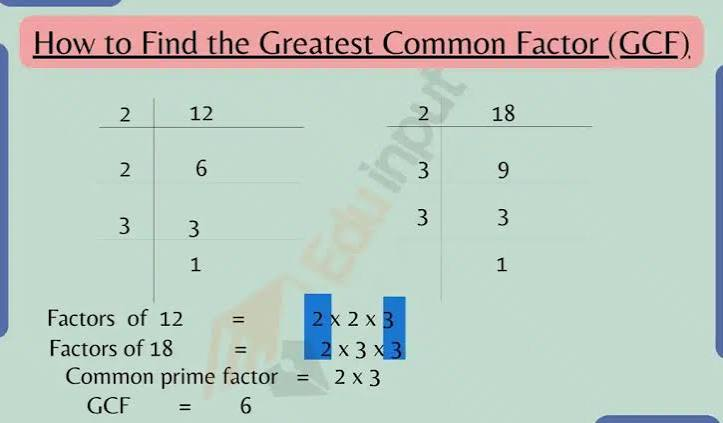
The greatest common factor (GCF) is the largest positive whole number that divides two or more numbers evenly without leaving a remainder. It is also called the greatest common divisor (GCD) or highest common factor (HCF). For example, the factors of 12 are 1, 2, 3, 4, 6, and 12, while the factors of 18 are 1, 2, 3, 6, 9, and 18. The largest factor shared by both numbers is 6.
To understand this concept, it is important to know what factors and common factors mean. A factor is a whole number that divides another number without producing a remainder. When two or more numbers share the same factors, those values are known as common factors. Finding the greatest shared value helps simplify mathematical expressions, reduce fractions, and solve problems involving equal distribution.
What Is a Greatest Common Factor Calculator?
A Greatest Common Factor Calculator is an online mathematical tool designed to identify the largest common factor of two or more numbers. Instead of listing every factor manually or performing repeated division, users can enter their values and receive an answer within seconds. It is especially useful when calculations involve several numbers or values that have many possible factors.
Many online calculators offer additional features that make mathematical learning easier. Depending on the tool, users may see common factors, prime factorization, calculation steps, and explanations of how the final answer was obtained. These features make the calculator valuable for students, parents, and teachers who want to check mathematical solutions while developing a better understanding of number relationships.
How to Use the Greatest Common Factor Calculator
Using a Greatest Common Factor Calculator is simple, even if you have limited experience with mathematical tools. Most calculators provide input fields where you can enter two or more whole numbers. Depending on the website, you may need to separate your values using commas, spaces, or individual boxes. Once the numbers are entered correctly, the calculator processes them and identifies their largest shared factor.
For example, enter 24, 36, and 48 into the calculator and select the Calculate button. The result will be 12 because 12 divides all three numbers evenly. You can verify the answer by calculating 24 ÷ 12, 36 ÷ 12, and 48 ÷ 12. Each calculation produces a whole number, confirming that 12 is a common factor of all three values.
How to Find the Greatest Common Factor by Hand
Although online calculators make mathematical work faster, learning manual calculation methods is equally important. These techniques help students understand why numbers share certain factors and how mathematical relationships work. There are several reliable ways to calculate the GCF, including listing factors, prime factorization, and the Euclidean Algorithm. Each method provides a different approach, allowing learners to select the technique that best suits their mathematical knowledge and the numbers involved.
Practicing these methods also helps improve problem-solving abilities. For smaller numbers, listing factors is often the easiest approach because the possible factors are limited. For larger numbers, prime factorization or the Euclidean Algorithm can be more efficient. Learning how these methods work makes it easier to recognize patterns, check answers independently, and understand the calculations displayed by an online tool.
Listing All Factors Method
The listing method is one of the simplest ways to calculate the greatest common factor. Start by writing down every positive factor of the first number, followed by every positive factor of the second number. Compare both lists and identify the values that appear in each one. The largest shared value is the GCF, making this method particularly helpful for beginners who are learning how factors work.
For example, the factors of 8 are 1, 2, 4, and 8. The factors of 12 are 1, 2, 3, 4, 6, and 12. Their common factors are 1, 2, and 4. Since 4 is the largest shared value, the greatest common factor of 8 and 12 is 4. The same process can be extended to three or more numbers by identifying factors shared by every value.
Prime Factorization Method
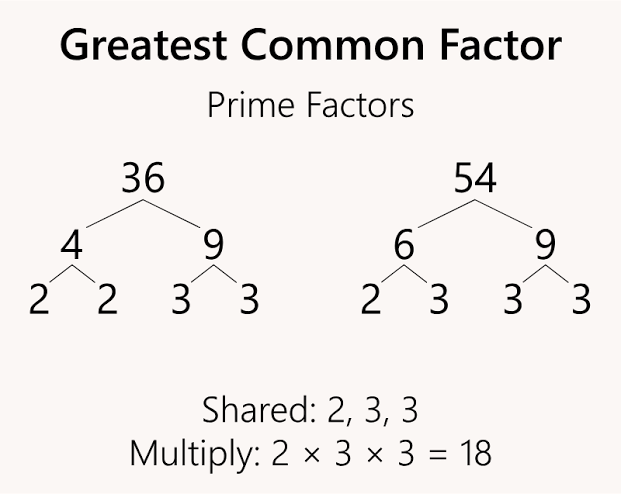
Prime factorization is another reliable technique that breaks a number into prime numbers multiplied together. Prime numbers have exactly two positive factors: 1 and themselves. To find the GCF, write each number as a product of prime factors, identify the prime numbers shared by all values, and multiply those common factors using their smallest exponents. This method is especially useful when working with larger numbers.
Consider 24 and 36 as an example. The prime factorization of 24 is 2 × 2 × 2 × 3, while 36 can be written as 2 × 2 × 3 × 3. The shared prime factors are 2 × 2 × 3. Multiplying these values gives 12, so the greatest common factor of 24 and 36 is 12. This approach also provides a clear explanation of how the answer is calculated.
Euclidean Algorithm
The Euclidean Algorithm is an efficient mathematical method for finding the GCF of two positive integers. It uses repeated division rather than listing all possible factors. First, divide the larger number by the smaller number and record the remainder. Next, divide the previous divisor by that remainder. Continue repeating this process until the remainder becomes zero. The last nonzero remainder is the greatest common factor.
For example, to find the GCF of 48 and 18, divide 48 by 18 to get a remainder of 12. Then divide 18 by 12 to get a remainder of 6. Finally, divide 12 by 6, which produces a remainder of zero. Therefore, the GCF is 6. This technique is particularly helpful for large numbers because it avoids lengthy factor lists and unnecessary calculations.
Greatest Common Factor Examples and Calculations
Practical examples make it easier to understand how the greatest common factor works in different situations. By examining calculations involving two numbers, three numbers, and larger combinations, students can learn how to identify shared factors accurately. These examples also demonstrate why an online calculator can be useful when several values need to be checked quickly.
For instance, consider finding the GCF of 20 and 30. Their common factors are 1, 2, 5, and 10, making 10 the correct answer. Similarly, the GCF of 12, 24, and 36 is 12 because all three numbers can be divided evenly by 12. Practicing different combinations helps learners understand that the same mathematical principle applies regardless of how many numbers are involved.
GCF of Multiple Numbers
Finding the GCF of three or more numbers follows the same basic principle as calculating the common factor of two values. Every number must be divisible by the selected factor without leaving a remainder. For example, consider 18, 36, 54, and 72. The largest positive integer that divides all four numbers evenly is 18, making it their greatest common factor.
Some number combinations may have a GCF of 1, which means they do not share any greater positive factor. For example, 8 and 15 are relatively prime because their only common positive factor is 1. When working with large combinations, an online calculator can help verify the answer and reduce the time required for manual calculations.
Benefits of Using an Online GCF Calculator
An online calculator offers several advantages for people who regularly solve mathematical problems. It reduces the need for repetitive calculations and provides quick results, especially when dealing with multiple numbers. Instead of spending several minutes writing factor lists, users can enter their values and check the answer almost immediately. This convenience makes online mathematical tools useful for students, teachers, parents, and anyone who wants to verify a calculation.
Another important benefit is improved learning. A Greatest Common Factor Calculator that provides step-by-step explanations can help users understand how a result is produced. Students can compare the calculator’s answer with their manual work, identify mistakes, and practice different methods. It also makes larger calculations easier to manage while allowing learners to concentrate on understanding mathematical concepts rather than performing repetitive arithmetic.
Real-Life Applications of the Greatest Common Factor
The greatest common factor has several practical applications beyond traditional classroom exercises. It can help people divide objects into equal groups, simplify fractions, arrange materials, and determine suitable measurements. These situations involve identifying the largest possible number or measurement that can be shared evenly. Understanding the concept makes it easier to approach everyday problems that require equal distribution without unnecessary waste or leftover items.
For example, imagine organizing 24 red balloons and 36 blue balloons into identical groups. The GCF of 24 and 36 is 12, meaning you can create 12 equal groups. Each group will contain two red balloons and three blue balloons. This example demonstrates how mathematical concepts can solve practical organizational problems involving equal quantities and balanced arrangements.
Simplifying Fractions Using GCF
One of the most common applications of the greatest common factor is reducing fractions to their simplest form. To simplify a fraction, identify the GCF of its numerator and denominator, then divide both values by that common factor. This process produces an equivalent fraction with smaller numbers, making it easier to understand and use in additional mathematical calculations.
Consider the fraction 18/24. The greatest common factor of 18 and 24 is 6. Divide the numerator by 6 to get 3, then divide the denominator by 6 to get 4. The simplified fraction is 3/4. Using this method makes fraction problems easier and helps students understand how common factors can simplify numerical expressions without changing their actual values.
Greatest Common Factor vs. Least Common Multiple
The greatest common factor and least common multiple are two important mathematical concepts, but they are used for different purposes. The GCF identifies the largest positive number that divides two or more values evenly. In comparison, the LCM identifies the smallest positive number that is a multiple of all given values. Understanding this distinction helps students select the correct method when solving different mathematical problems.
For example, the GCF of 12 and 18 is 6, while their LCM is 36. You would use the GCF to simplify fractions or divide objects into equal groups. The LCM is more useful when working with repeating schedules, matching intervals, or events that happen at different frequencies. Both concepts are essential in arithmetic and provide different ways to understand relationships between numbers.
Common Mistakes to Avoid When Finding GCF
Students sometimes make simple mistakes when identifying common factors, particularly when working with larger numbers. One common error is confusing factors with multiples. Factors divide a number evenly, while multiples are produced by multiplying a number by whole integers. Another mistake is selecting the smallest common factor instead of the greatest one. Remembering the definition helps prevent these errors and improves calculation accuracy.
Other mistakes include forgetting to include 1 when listing factors, overlooking shared prime numbers, and using incorrect exponents during prime factorization. When using the Euclidean Algorithm, incorrect division or remainder calculations can also produce an inaccurate answer. Always verify your result by dividing each original number by the proposed GCF. If every division produces a whole number without a remainder, the value is a valid common factor.
Tips for Learning and Practicing GCF
Regular practice is one of the best ways to develop confidence in finding common factors. Begin with smaller numbers and use the listing method to understand how factors work. Once you become comfortable identifying shared values, move toward larger numbers and practice prime factorization. Learning multiple approaches helps students recognize mathematical patterns and select an efficient technique for different types of problems.
You can also use a Greatest Common Factor Calculator to check your manual calculations and understand any mistakes. Try solving problems involving two, three, or four numbers, then compare your results with the calculator. If step-by-step solutions are available, review them carefully to understand the calculation process. Combining regular practice with online tools can strengthen mathematical knowledge and prepare learners for more advanced topics, including fractions, algebra, and number theory.
Conclusion
The greatest common factor is an important mathematical concept that helps simplify fractions, divide objects into equal groups, and solve problems involving multiple numbers. Understanding how to calculate common factors using factor listing, prime factorization, and the Euclidean Algorithm can improve mathematical confidence and make more complicated calculations easier to approach.
A Greatest Common Factor Calculator provides a convenient way to find the largest common factor of two or more numbers without spending unnecessary time on manual calculations. Whether you are completing homework, teaching mathematics, or solving everyday problems, this tool can help you obtain quick results and verify your answers. Combining online calculations with traditional methods is an effective way to save time while developing a stronger understanding of mathematics.
Frequently Asked Questions
What is a greatest common factor calculator?
It is an online mathematical tool that finds the largest positive number that divides two or more numbers evenly.
How do you calculate the GCF of two numbers?
List the factors of both numbers, identify their shared factors, and select the largest one.
Can a GCF calculator find the GCF of three or more numbers?
Yes. Most online calculators support multiple values and identify the largest factor shared by all entered numbers.
What is the difference between GCF, HCF, and GCD?
All three terms describe the same concept: the greatest positive integer that divides given numbers without a remainder.
Can the greatest common factor be 1?
Yes. Relatively prime numbers share only one positive factor, so their GCF is 1.
You May Also Read: www abithelp .com